Chapter 19 – The car is salvaged.

Chapter 19 Pic

The night was short, thank Goodness. It must have been two o’clock before we were bathed, bandaged and left alone. And at six daylight stole into the quiet white room. Soon after, the sister, clean and cool in her white robes, came in with tea and Humfrey woke. We took stock of our wounds. Humfrey’s face was covered with small scratches, probably from flying glass, and his finger was painful. My left leg had five or six deep wounds on the front and side of the shin bone and we were both badly cut about the arms. Otherwise we were unhurt, though we felt stiff and bruised. While we were washing with some difficulty, owing to our bandages, I was able to shave though Humfrey was not, owing to the cuts on his face, the sister came along to tell us a man was here from the store. She had sent for him to bring a selection of garments, as of course our own were still wet through. This is another instance of the thoughtful kindness that we met with at Niangara, instances multiplies a hundredfold in the days to come. We made a selection, trying excellent solar topees for the sum of one and nine pence each. Of course, we had no money, as it was all in the car but the trader, who had worked in London and spoke excellent English, made no bones about that. Breakfast was bought to us in a pleasant room with wide verandahs on three sides and a cool morning breeze blowing in at the open French windows. I could eat nothing but Humfrey made an excellent meal. He got quite cross with me because I would only sit and mope with my head buried in my hands. He said we were lucky to be alive and was, almost exactly, his usual cheerful self. Wonderful fellow!

While we were still at breakfast, a car drove up. The doctor, a cheerful young Belgian, examined our injuries and re-bandaged them. Before he had finished more cars arrived. The Administrator – the big man of the district – the Chief of Police, a hearty young fellow, full of optimism, and the Bishop, a marvellous little man with a grey pointed beard, very neat and dapper in his white robes and the gold cross hanging on his breast. These four held an inquisition as we sat in that pleasant airy room and were amazed to hear that we were unhurt after our terrific fall. Then the Chief of Police, Loerand by name, said lightly “Well, Mr Symons, now you will want to get your car out of the river?”

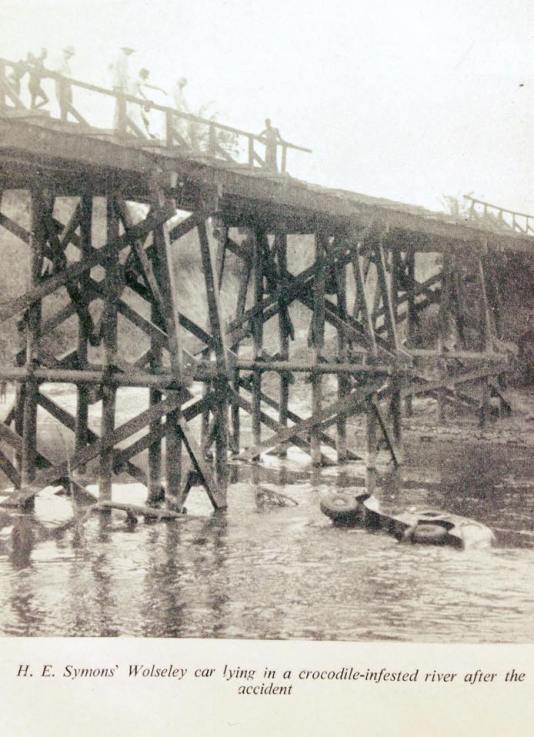
Symons said that he feared that would be impossible. Loerand replied “Nothing is impossible if one has enough men! I have already sent 50 prisoners to the bridge. I shall turn out two villages to help, and if that is not enough, I shall turn out two more.” We were still dubious. It seemed to us impossible that there could be anything left of the car after its fearful fall and its long immersion. But we agreed to go with them. Before we went, Humfrey borrowed from the sister her camera and some film as our own camera being of course submerged in the car. The Bishop drove us in his own Chevrolet, the other cars following. On the way we passed the 50 prisoners, in their uniform of black and yellow striped jerseys and blue shorts, marching towards the bridge. We arrived at the bridge. There, far below, lay our poor Wolseley on its side. Perhaps eight inches or so of the body with the open window through which we had climbed to safety above the swift water, and, as we looked down on it from the dizzy height of the bridge, it seemed impossible that we could have survived that ghastly fall. I remember distinctly the Administrator saying “Messieurs, veritably you have the good luck to still be alive.” We agreed. Loerand, the indefatigable chief of Police, would not hear of our doing anything, “No, no, you must be exhausted,” he said. “Leave it to me to arrange everything.”

Wolseley River

He sent a party away somewhere down the river to bring a dug-out canoe and meanwhile those prisoners who could swim stripped off their clothes and swam out to the car which was lying exactly in the middle of the river. Loerand called out something to one of the prisoners, who thereupon held his arm straight up above his head and let himself sink to the bottom. When he was standing on the bottom his up stretched hand was 4 feet below the surface. So, he continued to take soundings till it was discovered that, although the water was only about 5 feet deep on each side. It was clear that we had fallen exactly on a sandbank in the middle of the river. If we had fallen 3 feet to the right or the left, our car would have been in eight feet of water and would have been completely submerged. In that case we should never have got out alive. While we were waiting for the dug-out canoe to arrive, we all walked across the bridge to try and re-construct exactly what had happened. No other vehicle had passed, and the track of our car was plainly to be seen on the sandy road. We saw the straight line it had taken after rounding the bend 200 yards away; then the line deviated to the right as the car had swerved under the application of the brakes. Standing on this line and facing towards the river, we could see how the track was pointing towards the abyss of the high embankment, with the entrance to the bridge away to the left. This coincided with my recollections. I remember seeing nothing but a black drop in front of me and swinging the car towards the bridge. The track showed this. It was a perfectly smooth curve. A straight line, an outward curve to the right, an inward curve to the left, and this inward curve led on to the bridge at a slight angle. We could see a mark where the near side front wheel had struck the guarding baulk of timber and at the same point the outer guard rail was smashed away. About 20 yards further on along the bridge we could actually see a slight abrasion on the timber where the huge tyre had climbed on the baulk (although it had been rubbing along it, the soft flexible tread had given it enough grip to climb up the 10-inch high vertical side) and the track of the tyre was clear on the baulk, as it gradually veered towards the outer edge, and the two tracks were distinct where the wheels had taken their awful leap into space. The guard rail was smashed down all the way from the point where the car had struck it on entering the bridge to where we had gone over. We discussed the matter of what it was that had caused the car to go out of control and why I could not pull it back after it struck the baulk of timbers. Humfrey said that he was certain the first words I had uttered on emerging from the car were ‘The brakes jammed on” three times repeated. I did not remember it, but the doctor said that, from a psychological point of view, the first words uttered after emerging from a severe crisis are likely to be true even if the shock causes them to be forgotten afterwards. But the brakes had not jammed on because the wheels had not locked. All the way from the place where the tracks swerved to the right long before reaching the bridge until the point where the car went over the side, it was clear that the wheels had been rolling and were at no time locked. Some other explanation must be found. We believed then, and still believe after discussing the whole matter later with various people, that what happened was this.

Obviously the first part of the car to strike the upright of the guardrail when it entered the bridge at an angle was the front bumpers. We had found that the attachment of this heavy stabilizing bumper was the one weak point in the whole car. The method of attaching the bumper to the chassis was not sufficiently rigid to carry the weight of the bumper under the frightful conditions of the surface on which we had been travelling and the bolts had a tendency to come loose. We decided, and have had no reason since to doubt the connectedness of our diagnosis, that when the bumper struck the upright, the bolt broke and the bumper bar itself was smashed back and carried under the mudguard, between the tyre and the mudguard. It wedged there and prevented the wheel from running to the right when I tried to steer the car back towards the middle of the bridge. There can be little doubt that this was the true explanation. Meanwhile the dugout canoe had arrived and Loerand was poled out to the wreck. He decided that before attempting to place it on its wheels, it would be best to empty the car of all its contents as we did not know what damage had been done to the side of the body under water. If it was utterly smashed, all the contents might be left in the bottom of the river when the car was lifted up onto its wheels. Natives crouching on the side of the car, as we had crouched the night before, plunged their arms through the windows and extracted various articles. If we had felt in any mood for humour, it would have been amusing. A native’s arm would dive in and emerge with one gumboot from which he would proceed solemnly to empty the water before putting it in the canoe, or a sodden coat weighing a ton with its load of water appear or perhaps something hideous like an orange or a pot of jam. Almost at once Humfrey’s black bag was extracted, that black bag had held all the money. It was intact, though of course full of water. It seemed to go on for hours, this unloading of the masses of stuff one collects on a journey of this sort. While it was still proceeding, Humfrey told me that when we were leaving to swim ashore, it had flashed through his brain that we might be miles from civilization and need warmth. He had therefore searched in the car and extracted his wife’s favourite rug bought along by accident. Of course, being a thick woollen rug and also being soaked in water, it was enormously heavy, and equally, of course, after swimming 10 yards with it he had to let it go as he was quite unable to support the weight. Actually that rug and an old cap of mine were the only things lost, though our cameras needed some attention, which they got at Nairobi before they would work again and all the cine film, not very much owing to our unwillingness to stop for photographs, but valuable documentary evidence nevertheless, was utterly ruined, also about £30 worth of unused film.

img_3336

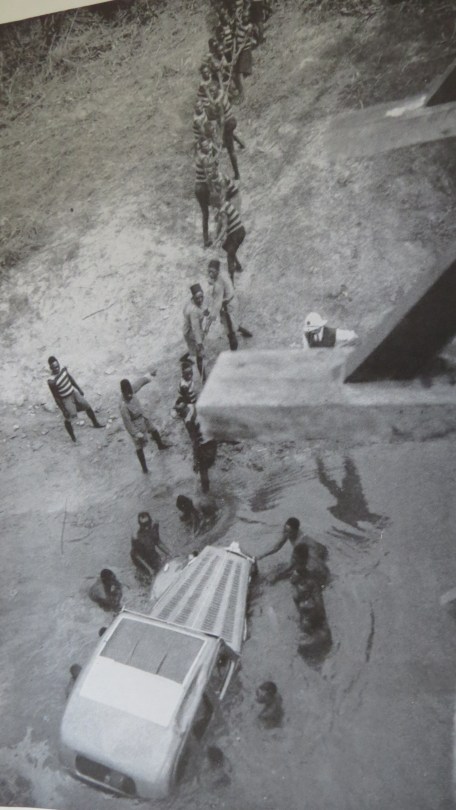
At last the natives announced that the car was empty, and two long ropes were floated out and attached to the front axle. Humfrey tried to persuade Loerand to fasten them to the chassis but without avail. Then about ten natives standing up to their necks in water, pulled the car up till it stood on its four wheels. It immediately sank until the roof was just below water-level: we had fallen as near the edge of the sand bank as that!

Now a great difficulty arose. The car was facing in the wrong direction. It had leaped off the bridge at an angle of perhaps 30 degrees to the line of the bridge and in its fall it had somehow turned completely round through 180 degrees so that it now stood, submerged, with its radiator pointing towards the bridge at the exact angle at which it had left it. In order to pull it out, the front of the car had to be got around through an angle of about 120 degrees. The method adopted was rough and ready, but it worked wonderfully. The natives in the water supported the side of the car to prevent it being pulled over while the villagers, about 150 of them by this time, hauled the front round by man force till it was facing in the right direction. Then every available man, woman and child was put on the two ropes and the car was dragged towards the bank. It was terrible to see our beloved car gradually disappearing under water as the bottom of the river shelved. We felt it would never emerge again. At the deepest part of the channel we could just see the white roof shining through 3 or 4 feet of water. But emerge it did, though every minute we expected the front axle to be pulled right off, for of course we did not know how much damage it had suffered in the crash. It might be now attached to the chassis by only the bolt. If the axle parted or the ropes broke, the car was lost forever, for the water was too deep for there to have been any possibility of getting a fresh rope to it. The axle did not part from the chassis and the ropes did not break and gradually the car began to emerge again, first the roof, then the radiator, and finally the wheels, when the front wheels were almost on the bank, the car stopped with the rear wheels sunk to the hubs in deep white clay. We had also noticed that the front wheels were not turning and the indefatigable Loerand discovered that this was due to the wings being so battered that they were resting on the tyres. A dozen natives, lifting with all their might, managed to tear them clear of the wheels, but still the car would not move, so deeply was the back part sunk in the mud. Humfrey suddenly thought to himself that of course the car was in top gear, so that the wheels were having to turn the engine and pointed this out to Loerand. The latter then told a native in the water to open the door so that he could see. The native did so and picked up something from the floor. Humfrey held it up, “Bertie, your glasses – unbroken!” he called. Something of a miracle that and, though of course I had a spare pair in my suitcase in the car, I was glad to have them back.

During this time, a large part of the prisoners had been set to work by Loerand to make a practicable path up the steep bank from the river to the road. This they did most efficiently, chopping down bushes and cutting away steep shelves of earth, till finally a rough sloping track, winding its way for some 50 yards through the scrub, was made. All hands were then set to the ropes and, giving a series of more or less concerted heaves to the signals of Loerand, the rear wheels freed themselves from the clinging white clay and with a plunge the car stood wholly on dry ground again. Then, laughing and shouting, the whole crowd of perhaps 250 natives, men, women and children, dragged the car up the track the prisoners had cut till finally it stood on the hard-sandy road.

We could then examine it and a sorry mess it looked. The body leaned drunkenly to the left, the side being some six or eight inches out of the vertical: the roof had taken a kind of twist from the deformation; the doors were gaping widely at the bottom: the windscreen had of course completely disappeared – it was made of toughened glass, not triplex sheet. The glass of the window in the rear door had gone and the front near side window out of which we had climbed was broken, with long sharp slivers remaining. The bonnet had been torn bodily away from its fastenings, though fortunately the natives had found it lying on the sandbank beside the car. The front wings were smashed and flattened till they resembled nothing so much as crumpled paper. Both headlamps and one fog lamp had disappeared and the side lamps on the wings were merely flat pieces of chromium plate. Inside the bonnet, the radiator stays were both broken, and the radiator block had been pushed back till the revolving fan had struck it, flattening the tubes. Lying underneath the car we examined the chassis and found serious damage. The rear hanger of the nearside front spring had been torn bodily out of the frame. It was riveted under the frame member and the rivets had not pulled out, but a piece of the steel had been ripped out, leaving the rear end of the spring free. Otherwise there did not appear, to a superficial examination, any vital damage but the tearing out of the spring made it impossible to consider driving the car if it were possible to get it going. It looked terrible, our beautiful car that had appeared so trim and neat, it looked an utter wreck and only fit for the scrap heap.

img_3335

By this time, it was noon and very hot. We were completely exhausted with standing under the blazing sun and Loerand insisted that we should return with the doctor while he himself would steer the car while it was pushed to the town by the prisoners. We had already made the experiment and found that the front wheels still answered a movement of the steering wheel, so that the steering connections were not broken. Feeling very despondent, we were driven back to the town by the doctor and along to the Post Office, where Humfrey cabled to Thomas and to his wife while I sent a wire to my sister with whom I live. Unfortunately, she was away from home and was horrified to hear on the wireless in the nine o’clock news that night an announcement that we had crashed. It was not until the next day that she received my reassuring cable saying that we were unhurt.

We arrived back at the hospital and feeling very gloomy, we found the car just arriving. Loerand told us that it steered quite all right but we looked at it with feelings of utter hopelessness. It was such a complete wreck. Water poured from it everywhere and we were further dismayed seeing a steady drip of oil from the back axle which seemed to betoken some serious damage there. When Loerand got out of the driving seat, he surveyed rather ruefully the seat of his white duck trousers. Dunlopillo cushions, though exceedingly comfortable to sit on, are not well adapted for immersion in water as they act exactly like a sponge and a large black wet patch showed where Loerand had been sitting. He came in and had a drink with us – our whiskey bottle in the car being still intact – and left for his office after receiving our heart-felt thanks for his efforts on our behalf.
img_3337

We had lunch and I managed to eat something at last. Over our meal we discussed the future. We ruled out at once any question of being able to go on, a bitter decision but one that seemed to us inevitable under the circumstances, as there were no facilities of any sort for the execution of repairs at Niangara. We decided that the only possible thing to do was somehow to get the car conveyed to Juba, where it could be shipped home by Nile steamer while we ourselves would probably return home by air. We both felt anxious to reach British territory, for there we should at least have the feeling of being among our own people and we proposed to find out if there was any way of getting our car conveyed or towed to Juba, 330 miles away.

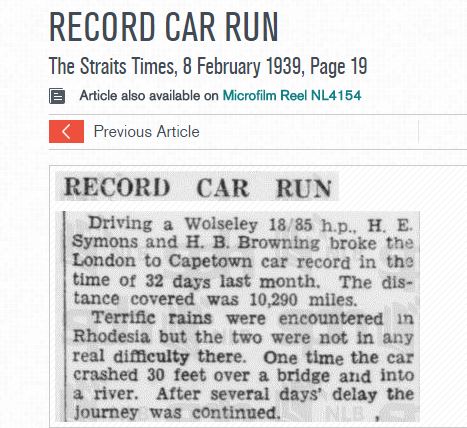
We had just finished lunch when a telegram was brought in. It was from Thomas and it put is into a serious quandary. It said “Sorry to hear of the accident. Please cable immediately car total loss. Cable your plans.” It was plain to us that Thomas naturally wished, if the car was lying wrecked in a river, to claim under his insurance policy for the value for which it was insured. But here was the car, though wrecked, standing outside the door and, as I said, it seemed a shame to take it back and push it into the river again. We sent off another cable making the worst of the damage for Thomas to show to the insurance company; but still we were determined that, if it were in any way possible, we would get the car home as salvage, if as nothing else. That afternoon I wrote to Thomas, explaining exactly what had happened. I shall refer to his reply to this letter. We went out to the car, removed the six spark plugs and turned the engine round by hand. It was quite free and as we turned it great jets of water six feet long shot out of each plug holes in turn. We were relieved to see this because we were afraid that as the engine had been running when it entered the water, it might have sucked in water through the carburettors and that the pistons might have been smashed as they came up, water being incompressible. If this had been so, or a connecting rod broken, there would have been no corresponding jet of water from that cylinder when we turned the engine round. So, we were relieved of that fear. When no more water came out, we squirted oil into each plug hole to arrest the savages of rust and replaced the plugs. There was no more we could do, and the engine was not touched again until after we reached Juba, 5 days later.

We stayed at Niangara for four days, meeting with nothing but kindness from everyone. The Administrator gave a cocktail party in our honour and we gave one in return at the hospital where we were kindly permitted to remain, as it was exceedingly comfortable and the food excellent. It was ridiculously cheap: I think we were charged 8/6 a day each including all our meals and medical attention.

Eventually, after some disappointments, we made arrangements with a young Belgian farmer, Lenoire by name, to convey the car and ourselves to Juba, 330 miles away, by lorry. When we asked him how much he would charge, he asked us if 1000 francs would be too much! As this represented about £6.10.0, it struck us as the cheapest form of conveyance we had ever heard of for 660 miles for £6.10.0! Well, well! What would it have cost in England?

 

Chapter 18 Part 2 – Disaster – Bambili Ferry – Bridge at Niampara 159 miles 1 January 1939.

Disaster

With Humfrey at the wheel we set off from the ferry at 6.34pm. I remember distinctly, Humfrey saying “Well, Bertie, this has been the best days motoring we’ve had since we started,” and my cordial agreement. Rested after a good night’s sleep at de Boose’s house, we had not felt at all tired, the road surface had been respectable, we had had a good lunch, and the weather had been delightful, hot but not unpleasantly so. We were feeling very fresh and fit and were eagerly looking forward to reaching the Sudan border about 500 miles ahead, where we should enter British territory, never to leave it again, all the way to Cape Town, nearly 5000 miles away. As Humfrey drove steadily forward into the darkness and we compared notes as to our feeling, we saw ahead a distant flicker of lightening. “Oh Lord,” said Humfrey “I do hope we aren’t going to run into another storm and waste a lot more time.”

Waste a lot more time! I agreed. It would be maddening to meet with more difficulties after this pleasant day. Two hours after the ferry, Humfrey handed over to me. He put the seat into its sleeping position as he said he would get some sleep before we reached Nianpara where we were to re-fuel.

It was 8.35pm when I took over, and Humfrey dropped off to sleep at once. I have never felt less sleepy in my life and I was thoroughly contented as I drove steadily forward over the good road. I passed through a large village and just beyond it the road forked. There was a signpost at the fork. I was pretty sure that we ought to go to the left, but it was better to be certain. I stopped and, as I had slightly overshot the turn, I reversed a few yards to get the headlight beam on the sign. The right-hand arm said “Dingba” and I remembered that this place lay off to the right of our road, so I was just starting off again when Humfrey stirred and sat up, disturbed by my reversing. It is a curious fact that anyone asleep in a car is invariably awoken by the car being reversed: presumably the change in direction affects the subconscious mind. He said sleepily, “Where are we?” I said that we had just passed Tapili. He reached for the logbook, looked at the dashboard clock, wrote 10-7 opposite the name “Tapili” and, dropped back on the cushions, was asleep again at once.

Later I remember looking down at the dimly lit clock and noting that it was 10.35pm, in other words that I had completed my two hours turn. Then I looked at the mileage on the speedometer and, making a mental calculation, decided that as it was only about 15 miles to Nianpara where we were due to stop for petrol and as I was not at all sleepy or tired, I decided that I would drive on to that place and not disturb Humfrey.

Steadily, at about 40 mph, I drove on. I was doing sums in my head and reckoning that we should just about reach Nianpara at 11 o’clock. The road rounded a gentle left-hand curve, for which I slowed, probably to about 30; once on the straight again, I believe that I looked down at the speedometer or clock. Looking up again, I saw in front of me perhaps 100 yards ahead, two tall posts marking the entrance to a long narrow bridge while the road ran out on to a high embankment. I lifted my foot from the accelerator and braked to slow for the entrance to the bridge. The car, owing to the unequal pull of the brakes to which I have already referred, swerved to the right and I was startled to see ahead the blackness of a great abyss with the narrow entrance to the bridge away to the left.

One’s recollection after a disaster is apt to be rather blurred but I distinctly remember being startled to see the car heading to miss the bridge entrance altogether. I turned the steering wheel sharply to correct the swerve under the brakes and entered the bridge at an oblique angle. I must digress for a moment to describe the exact construction of this bridge as it is of some importance in what occurred. The bridge was about 140 yards long and spanned the River Gada, 40 feet below. It was narrow, just wide enough to take a lorry comfortably. The surface was of transverse planks and on each side, there was a huge longitudinal baulk about 10 inches square, while outside that there was a stout guard rail made of square timber about 4 inches square, carried on upright posts. To resume; the car entered the bridge at an angle travelling, probably, at 30 to 35 miles an hour. I felt a jar as the nearside front wheel struck the left-hand baulk of timber and there was a sound of splintering wood. To my horror I found that the car would not answer the steering, so that I was unable to straighten it out; there was more crashing of timber and a great jarring and bumping as our huge tyres climbed on to the baulk. While I wrestled with the wheel, the car ran along the top of the baulk for 40 yards or so, smashing down the outside guard and then suddenly and smoothly leaped bodily over the side of the bridge down into the black chasm below. I am not going to pretend that I remember anything of that hideous leap into the darkness. I am conscious of only one thought that flashed across my mind as the car fell. “This is the end. We are dead.”

Wolseley River

Oddly enough, after that awful plunge, I remember no crash as the car struck the water. I only knew that I was under water, inside the car, in a horizontal position and struggling, though with no hope of finding a way out in the blackness of the water. I knew that thoughts of Humfrey flashed into my mind, with deep grief that he was dead too, but for myself I was so convinced that I was already dead that, although I struggled to escape, I was not particularly worried about it. I had already begun to take in water as I could hold my breath no longer and it was easier not to bother, since I was already dead when, suddenly and incredibly, I breathed air. My head had risen above the surface, and I seemed to be standing up though I was still inside the car, and I heard a frantic voice calling “Bertie, Bertie.” It was Humfrey, so he was not dead either!

I saw a window near my head and put my head through. Humfrey clutched me and I climbed out; we were both crouching on the side of the car, as it lay on its side in about 5 feet of water, and high above our heads the bridge with its smashed guard rail was outlined against the starlit sky. We had come from there. Right down from there and we were still alive. It was incredible.

My nerves had utterly gone, and I was like a shell-shocked man. The horror of that rush across the bridge in an uncontrollable car, the noise of the smashing timbers and that hideous leap into the black abyss had temporarily deprived me of all self-control. Even now, after the lapse of many months, those ghastly moments are apt to creep into my mind so that I have to fight away the memory of them.

Humfrey, wonderful fellow, was as calm as though he were seated in his own drawing room at home instead of crouching on a wrecked car in an African river in the middle of the night. He had been asleep and dreaming. He was conscious in his sleep of a loud noise and much shaking: then he had dreamed that he was in the water and had thought “This is a damned unpleasant nightmare. I hope I shall soon wake up.” Suddenly he realized that it was not a dream that he really was in water, and under water. He thought, “Bertie’s driven into a duck pond. I must get out.” Finding an open window just above him, he had got out to find the car lying in the river and himself crouching outside; almost immediately afterwards, I had appeared and joined him.

He swears that the first words I uttered were “the brakes jammed on” – three times repeated. I have no recollection of this, but I will refer to it again when I come to the dissection of the cause of the accident.

The first thought that occurred to me when I arrived out of the window was, I am sorry to say, not thankfulness for our miraculous escape, but the fact that the trip, so marvelously began, was now ruined, that I was responsible; that Humfrey was my best friend and, well many other hideous thoughts of this sort, perhaps better forgotten.

Humfrey, as I have said, was perfectly calm and said, “We must get out of this – must get to he bank.” I, with some sort of insane idea that we were safe here, muttered “oh, no, no.”

“We can’t stop here,” said Humfrey, “All these rivers are full of crocodiles and we must get to the bank at once. The splash will have driven them away for the time being.”

I looked round. I could not see very well and discovered that I had lost my glasses in my struggle inside the car. We were crouched on the rear side of the car, which protruded some eight inches or so above the black oily water that streaked past the wreck.

The headlamps, under water, were still shining beneath the surface and threw a ghostly light into the depths. Humfrey said “We must go. I wish we had some lights to train on the bank.” Then, “Ah this spotlight!’ We had a spotlight mounted high up on the side of the car on the near side above the windscreen, and this, although the bracket was broken off, was still attached by the wires. “I wonder if it would work,” said Humfrey.

“I can reach the switch,” I uttered. I reached inside the broken window through which we had climbed to safety and found the switch. The lamp worked and Humfrey swung it round and pointed it to the bank. Meanwhile I remember that there was an electric torch in the cubby hole on the rear side of the car. I reached in and found it. It worked.

“Come on, Bertie, we must go,” said Humfrey, “before the crocodiles come and this spotlight won’t last long with the battery under water.”

We slipped down into the cool, fast running stream, and (we have often laughed over this since!), just as we were preparing to leave the car, Humfrey, in his most prosaic voice asked, “By the way Bertie, can you swim?” “Yes,” I answered. I wonder what he would have done if I had answered “No!”

Without glasses I am so shortsighted as to almost blind and Humfrey held me by one hand, with the lighted torch in the other as we battled across the rapid current towards the bank. We had about 50 yards to go and we landed a long way down below the bridge, so fierce was the stream. By the time we had swum the river, the spotlight on the car was out as the battery, short-circuited by the water, gave up the ghost. We lay panting in the reeds, but Humfrey gasped “We must get up the bank. The crocodiles will get us here or there may be snakes.” We climbed the steep bank to the road and lay exhausted for some minutes. Humfrey asked me what had happened, but I was so shattered that I could explain nothing and could only gasp that I had ruined the trip and him and everything.

Humfrey said, “Forget all that. It won’t do any good. We must find someone and get help.”

Then he asked me if I knew where we were. I could not remember, but said I thought we were 10 miles from Nianpara. He said that he remembered the bridge quite well and he thought it was only 2 miles from the town. We took stock then of our injuries. They were not serious. Humfrey was a horrible sight. His face was covered with blood which we found afterwards were caused by surface scratches from flying glass, but he looked ghastly. Also, he had damaged the little finger of his left hand: he thought it was sprained but afterwards it was found to be broken. I had some deep cuts on my left leg probably caused as I climbed out of the broken window and we were both cut about the arms. Otherwise we were uninjured. We set off to walk towards the town. Humfrey, who had been wearing his jacket to keep him warm as he slept, took this off and also his shirt as he had some idea that he would be less likely to catch a chill without them. As a result, his teeth were soon chattering, and he was shivering with cold. I was wearing only a shirt and shorts and was too miserable to bother about whether I got a chill or not.

We walked in the darkness and it was not a happy walk. All our hopes lay with the car in the bed of the river. Humfrey kept saying “Cheer up, Bertie. We’re alive anyhow.” That didn’t cheer me up at all. I felt I would be better dead. No, not a happy walk.

We found a native village. Humfrey had an idea we might get help here and insisted on explaining, though I urged him not to do so. I was afraid. He actually entered a hut and found an old native woman jibbering with fear in the light of the torch. Humfrey said “Homme blanc, homme blanc,” meaning that we wanted to find a white man, but she only glared in terror.

On again and another native village. This time in the first hut he tried, he found a young native woman, whom he described as “quite attractive”, but she also simply stared with horror at this frightful apparition of the night. Far away in the scrub on our right we could hear the beating of drums, that perpetual ever-recurring thudding that echoes in the ears of everyone who has visited the heart of Africa, the mysterious drums of night.

At last as we plodded along the road, we saw the light of a fire and natives dancing round it. We approached the fire and Humfrey said “Homme blanc, homme blanc.” They roared with laughter as though we were some tremendous joke got up for their benefit. Suddenly one of the men snatched a burning brand from the fire and held it up high. He saw Humfrey’s face covered with blood and the blood pouring from the wounds in my leg: at the same moment a woman touched my sleeve and said something. No doubt pointing out that it was wet. I think they realized that something had happened. White men do not as a rule walk about in the Belgian Congo in the middle of the night, at any rate not covered with blood and wet through. They listened attentively when Humfrey repeated “Homme blanc, homme blanc.” Then one of them said clearly “Mission, mission Romain.” A Roman Catholic mission! That was the idea. “Oui,oui,mission,” cried Humfrey and pointed north, south, east, west, as if to ask where it was.”

The natives went into committee on this and eventually the scene by the light of this blazing fire ended in our setting off towards the town escorted by a large part of the village. It would have made a lovely scene in a film, that procession. First came a native carrying a huge flaming torch, followed by Humfrey, clad in his shorts, walking so close to the torch in the effort to get some warmth into his body that he was almost scorching his bare chest, as he beat his arms round his body to try and get some warmth into it. Then more natives, then myself, leaning my arm on the shoulder of a young native girl who, seeing that I was limping from the pain of my cut leg, had taken my arm and placed it on her shoulder. A graceful action for which I am afraid I was not as grateful as I ought to have been. I was still too shattered in my nerves to be normal. Then a lot more natives followed, chattering gaily.

We went on for what seemed like a hundred miles till we saw a large sign by the side of the road, the most welcome sign I ever saw in my life. It said “NIANGARA. VITESSE MAXIMUM POUR AUTOS 20 KM”. Immediately after this sign, our natives turned off the road towards a large building on the right. They went up to it and one of them banged on the shut door. After some time, a sleepy voice asked in French who was there. Humfrey explained that we were travellers who had met with an accident. There was some grumbling and a sound of movement. Then the door opened. There appeared at the door an enormous bearded man dressed in pajamas. He shone a torch on our faces and arms. “Mon Dieu, mon Dieu, mon Dieu! What has happened?”

Humfrey explained that we had fallen with our car into the river; also, that we were not seriously injured but needed some medical attention.

“My son,” said the large priest, “you are fortunate in that you have arrived at the very best hospital in the Congo. If you will go over to the building across the road, I will send the sister to you.”

Humfrey explained that we were wet and that of course all our clothes were in the river with the car. The reverend father produced at once pajamas of such a vast size that when I came to put them on the front part met at the back and the cord went twice round my waist! I saw on his table a packet of cigarettes and begged a cigarette. He thrust a packet on me. Then Humfrey said “Mon pere, these natives have bought us here and all my money is in the car in the river will you give them something for me?”: Assurement,” he replied. From his table to take a couple of packets of cigarettes and, going out, he divided them among the natives.

Apparently, there was some trouble; one of them said that it was not enough or something like that. Immediately, the enormous bearded priest, rushed madly at the party of surprised natives, slapped one of them across the face and kicked another’s behind as they all ran off screaming and laughing. “It is nothing,” he said returning, “they are used to it! Now I will fetch the sister if you will go across the road to the hospital.”

We went off towards a large brick building with a wide verandah. We were deadly tired after our walk following the shock of the accident, but in a very few moments the sister arrived clad in clean white garments. She introduced herself as Soeur Marice deBoose l’Annonciation’ but she was really an angel in disguise. She spoke English well. She opened the door of a clean white painted room with two beds and ushered us in, while native boys came running with basins of water, rolls of bandage and dressings. As she was washing our wounds and bandaging our various cuts, she asked what had happened. Humfrey explained that we had fallen over the bridge about 6 kilometers out and when at last she understood that it was indeed the high bridge over the River Gada she was amazed that we were alive.

While bandaging us, she told us that she was sorry she had no whisky, but she had ordered some tea to be got ready for us and wine was being brought. The hot tea soothed our jangled nerves and the wine was comforting. Humfrey wrote out a cable to Thomas at Wolseleys and she promised to have this dispatched first thing in the morning. The actual words were “Crashed through bridge in Congo. Car wrecked. Both unhurt.” (This was delivered to Thomas reading “crashed through brigade” but he did not believe that we were likely to have decimated the army of the Belgian Congo and correctly interpreted the word as “bridge”). She also promised to arrange for a sentry to be sent out to the bridge before daylight to ensure that natives did not swim out and loot the car. Humfrey was chiefly anxious because all our money – some £150 – was in the car.

Then, leaving beside each of us a glass of some sedative and a couple of aspirins in case we could not sleep, and lighting a candle which she sheltered behind a book, she wished us goodnight and left us.

I attempted stumblingly to express to Humfrey my regrets for what had happened, but he said “Forget all about it, Bertie. We’re alive anyhow.” And that from first to last was the only condemnation I received from him for what was undoubtedly my fault. He has never to this day said one word of blame or abuse for the ruining of our high hopes. One cannot but wonder what some men would have said!

I lay in the dim white painted room, listening to Humfrey’s quiet breathing for he fell asleep almost at once. For my part I left the sleeping draught and aspirin untouched. I was determined that at any cost I would not sleep. I was afraid of what I might dream. So all the remainder of that most bitter night I lay quietly in my bed, visualizing the consternation that would shake the Wolseley Works when the cable arrived, visualizing Thomas’s anger, the dreadful business of home-coming that we had cherished so long, the end of the attempt of the Cape Record. Every now and again the horror of these ghastly moments would come over me again, the black abyss, the blow, the crashing of timber during our uncontrolled passage along the bridge. The awful leap into the blackness below, the struggle for life in the black water, the hideous memory of crouching there on the side of the car just above the oily water streaking past and the great bridge with the eloquent gap in its rail towering above our heads against the starry sky. I fought these visions away, but they would keep recurring. But mostly the feeling of that ghastly leap down into the black night. I was not thankful for our miraculous escape; for Humfrey’s, yes, but not for my own. Bitterness flooded me so that I wished I was lying still and cold with our beloved Wolseley beneath the black river. For everything was lost now. Dreams and plans and visions of triumph. There remained only the hideous memory of that awful fall. That and the bitterness of Humfrey’s goodness. No, not a nice night.

Chapter 18 – Part 1

Chapter 18“As we drove past the trunks of the mighty trees, strewn asunder and dragged clear by the working party, we decided that if we were ever again caught in a storm in a forest we would stop at the first convenient clearing. Everywhere along the road there were traces of the great storm, trees had fallen in the forest and were leaning against their neighbours, and debris of branches and boughs were scattered far and wide. The road was perfectly dry and the conditions perfect. We were very contented, feeling fit and refreshed after our good night’s sleep. Of course the delay was a nuisance and had upset our schedule completely. Whereas, at the ferry across the River Bibi, some 20 miles before we met the storm, we had been a mere matter of 2 hours 40 minutes late, we were now hopelessly behind. Actually about 16 hours and this meant a complete reorganization of our plans. We decided, however, to do nothing about it until we reached Juba in the British Sudan, about 800 miles further on. There we should be in direct telegraphic communication with Nairobi and could telegraph fresh instructions as to the time we shall arrive there. Meanwhile there was nothing to do except to plod steadily along. Only one thing we would have to do and that would be to send a telegram from Buta, 170 miles ahead, to the Governor of the Southern Sudan at Juba, to inform him of our delay. The reason for this was that we had expected to arrive at Juba in the early hours of tonight, about one in the morning, and he had kindly promised to arrange for the ferry which does not normally cross the river after dark to be waiting for us to take us over to the eastern bank. We could not now hope to arrive at Juba before the next afternoon and we felt that it would only be polite to send a telegram. Actually this telegram was never sent from Buta, because we were told on our arrival there that we should certainly get to Juba before the telegram! As events turned out, it was just as well we did not wire. While we were discussing these matters, we passed through a large native village which seemed, even to our not very interested eyes, to be in an unusual state of alertness.  A quarter of a mile on we found the cause. A huge tree, six feet across the trunk, lay squarely across the road, felled by the storm of the previous night.


We had hardly stopped, with a few hearty causes at the prospect of a fresh delay, when from the village there came running men, women and children. In this neighbourhood where storms are frequent and trees are often down across the road, the villagers are responsible, as a part of their dues to the Belgian authorities, for removing any such obstacles and keeping the roads clear. I hesitate to impart commercial motives to these untutored sons of nature, but I think there can be little doubt that they had known of this tree blocking the road and had been hoping for just an eventuality as had occurred, the arrival of a car, before they felt compelled to clear it away! Obviously it was likely to be more profitable to await the arrival of travellers rather than to clear the road without anyone having any knowledge of their good work!

I will say that those natives knew their job. Men, women and children attacked the tree. The men with swinging blows from their axes chopped the tree into three, while women and children tore away smaller branches. In 36 minutes they had finished the job, rolling away the centre portion to leave a passage for the car. Humfrey filmed the scene as they pushed the centre portion clear and I drove the car slowly through. After distributing the necessary largesse in the form of small change and cigarettes we drove on, hoping fervently that this sort of thing was not going to occur every 20 miles.

Shortly after, we drove down the slope to the ferry at the trading station of Bondo, an important place on the banks of the great River Wele. The ferry, a regular super-ferry this one with a crew of about 30, was on our side and we were over and away in 15 minutes. Here we left the great forest region and entered the fertile fields of the great Belgian colony, where the land was tilled and cotton was the staple crop. A cotton field is a pretty sight; cotton grown on long stalks about four feet high and each stalk is topped with a fluffy white ball, so that the field looks for all the world like a gigantic bed of white flowers. It is a smiling, pleasant, prosperous neighbourhood and every now and again we would pass huge red brick ginneries of the Cotton Co. It is a thickly populated country and we began to feel as though we had reached civilization at last. 30 miles after Bondo we crossed the river Likati by a most ingenious method, which filled us with delight because it saved so much time. Here the road climbs steeply up to the railway track, for there is an old railway here that , according to the map, begins nowhere and ends nowhere, a native comes forward, takes 10 francs as a ferry fee, opens the gate and one drives across the river along the bridge which carries the single line railway. Presumably his job is to see that one doesn’t meet a train on the bridge but – well, natives are not notoriously efficient!

Eight miles on, one crosses the Likati again, but this time by a normal type of native ferry. We had covered the 38 miles from Bondo in 64 minutes including the railway bridge ferry, so it can be judged that the road is not bad. The road – or track or whatever one likes to call it – is sandy and smooth and makes very pleasant and comfortable travelling. It is not, of course, a made road in the sense that roads in Europe are: by this I mean that it is not installed, but is simply the smooth beaten natural soil. We were thoroughly enjoying ourselves. It was a lovely day, not too hot, with a bright blue sky and brilliant sunshine: the country had a pleasant aspect and even record-breaking motorists have a preference for agreeable scenery! We were fresh after our good night’s sleep and the car, needless to say, was running perfectly. What more could the heart of man desire? We were very happy and contented. The date, January the 1st, then meant nothing to us except that it was New Years day. It bore no hint of the disaster ahead.

It was 1.39 pm when we drove into Buta, where we were due to re-fuel at the Shell Depot, here as throughout the Congo, known as SEDEC. We had only averaged 30m.p.h. from the Likati ferry, the reason being, I think, that we had been enjoying ourselves too much to want to hurry – all time motorists will know what I mean! After some little difficulty we found the Shell Depot where there was, a delightful surprise, an Englishman in charge. He said that he had been told to expect us the night before and had waited up for us. We had, therefore, to explain our delay. We refueled from a Shell pump, gave the steering a shot from the grease gun and drove to the hotel. It is a most swagger affair, this Hotel Vicicongo, one enters a large lounge on dining room with a shining bar in one corner and we felt suddenly that we needed lunch. Madame was agreeable to supply us although it was well past the usual hours and we sat down at a proper table, with a cloth and shining cutlery. Except for the fact that the servants were black one might have been in a comfortable provincial hotel in France or Belgium. It was all most sophisticated. After an excellent lunch we set off again, having spent 1 hour and 8 minutes at Buta. A grievous waste of time, but we were quite contented to loaf on this most delightful of days. It was a quarter to three when we left and we were anxious to reach the ferry – once again across the River Uele – at Bambili, our last Congo ferry, before it was dark as there was some doubt as to whether it could be persuaded to function after night fell. It was 132 miles to Bambili and the country became gradually less appealing and began to take on the dried up look that reminded us of French Equatorial Africa, but the road remained good and we covered the 132 miles in 3 hours and 23 minutes, exactly one minute under schedule (with which accurate forecast I was highly delighted). We reached the River Uele at 9 minutes past six and were unlucky enough to find the ferry on the opposite side bringing a lorry across. So it was 25 minutes before we were over and away on the other side. It was then quite dark, but the night of January the 1st meant nothing particular to us yet.”


Chapter 17 A Narrow Escape

Chapter 17

“As we left Monga and drove towards the east, we saw in the sky ahead a flicker of lightening. I think that both of us saw this, but we each carefully refrained from making any remark about it. As we neared the ferry 9 miles beyond Monga the flashes became so frequent and so obvious that it was impossible to ignore them any longer. Humfrey said, “I do hope that doesn’t mean a storm ahead, Bertie.”

“Oh, no,” I answered as casually as I could manage, “only summer lightening.”

We went on kidding ourselves in this way as we drove the car on to the ferry, crossed over the small River Bili and landed on the other side. But soon it wasn’t any good pretending any more that it was only summer lightening. Darkness fell as we started off again from the ferry and ahead of us all across the black sky, brilliant flashes of lightening flickered. The lightening was not just in individual flashes, as we see in our English thunderstorms but it was absolutely continuous: in five or six different places in the sky at the same time the jagged streaks flared out, so that it was just like some giant pyrotechnic display or as if some small boy was playing with the electric light switch. When we had covered some ten miles or so, the storm seemed to roll away to the north and we began to hope that it might have passed before we passed its path. Suddenly, while we were discussing the possibility a roaring peal of thunder crashed out, and right across the sky, directly on our path, the lightening flared.

“We’re in for it, Bertie,” said Humfrey.

“I’m afraid we are, “I replied.”

They drove into the Congo forest with trees as tall as 80 – 90 feet in height. The storm was all around them with lightening flashing and thunder crashing as the rain came cascading down – the windscreen wiper was unable to deal with the torrential rain. They drove in second gear at 10 miles an hour. The thunder got louder and suddenly Humfrey jammed on the brakes so fiercely as to lock the wheels and we stopped just 100 yards from where, a huge great tree, 80 feet high or more, lay white-hot and smoking directly across the road. They only had a small axe and they needed help. Their log book had a record from the previous trips that there was “a European house on the right.” Humfrey decided to go and try to find the house armed with only a torch.  Bertie was quite nervous about Humfrey being in the forest on his own and he started to fear the worst. Finally Bertie decided to get out the car and call for Humfrey. At last Bertie saw the beam from the torch and was relieved to see Humfrey.

“I told him that I had thought of a gorilla. He replied that he was glad that hadn’t occurred to him, but he had decided, as he could see no sign of any village and it was most inadvisable to wander about Africa in the dark armed only with a torch, to return to the car. I said I had been terrified.”

They turned the car with some difficulty and decided to return the 20 miles to the ferry. They were creeping slowly along while feeling disconsolate “when I suddenly shouted “Look, Humfrey, the European house! there on the right! I remember it quite well.”

“We must have passed it in the rain storm,” said Humfrey, “without seeing it.” He turned in at the gateway, stopped in the compound outside the door, and blew the horn. A young Belgian by the name of de Boose appeared – he was home as it was New Year’s night. He invited them in for dinner and organized about 30 natives to go and remove the tree. de Boose exclaimed to Humfrey and Bertie “Good heavens! You took the most fearful risk in continuing to drive through the forest in the storm. If one is caught anywhere near here when the trees are so thick there is only one thing to do and that is quickly to find a clearing where there are no tall trees on either side that can reach the road if they fall and stop in that clearing until the storm has ceased”.

Later that evening the foreman sent back a message that there were in fact 6 trees that had fallen. “Six trees in half a mile! Humfrey and I looked at each other but neither of us voiced the thought that was in the minds of us both. We must have stopped on the very fringe of the storm’s path! Our tree was the first! There were five others down in half a mile! Suppose we had been a quarter of a mile further on, in the midst of those six falling trees! Well! We looked at each other and silently lifted our glasses.”

Bertie slept well but Humfrey had a buzzing in his ears. “He put this down to the effect of the continuous travelling telling upon his nerves.”

They woke early to find the sun shining in a cloudless sky and enjoyed a hearty breakfast. Humfrey thanked de Boose and his men and he paid the men a couple of hundred francs and some cigarettes for their assistance.

“Our good engine sprang to life at the first touch of the starter in spite of its soaking of the night before and at five minutes past eight we drove away with heart-felt thanks to our young host for his hospitality.”

Chapter 16: The Belgian Congo. 77 miles 31 December 1938

Chapter 16

“At last Humfrey arrived and we boarded the ferry for the long paddle across the river. We had arrived at Bangasson at 1.25pm and by the time we drove away from the Belgian side of the ferry it was 3.55. Actually our stop here had not occupied 2½ hours, but 1½, as we had here put our clock on 1 hour to compensate for the later time as we travelled east. None the less it was now 3.55. We had been due to leave Bangasson at 1.30, so we were 2½ hours behind schedule. Still, we had now travelled over 5000 miles, so perhaps it was not so bad.

It is worthy of mention that, in an account which I read lately of a journey across Africa by car, the author wrote “our passage across French Equatorial Africa brought us the worst roads of the whole of our journey from Rhodesia to Algiers and it took us six days of really hard driving before we reached the border of The French Cameroon.” Six days of really hard driving! It had taken us exactly 30 hours!! Such is the difference between touring and record-breaking! We left the ferry over the Ugangi River and drove, over a very indifferent and disappointing road, to Monga, a pleasant little place where is the Belgian Customs Post was. A Belgian flag floats proudly from a tall flag pole in front of a white thatched building where a cordial and efficient official stamped our papers, while expressing the usual amazement at the date of our entry at Algiers. “Ma Foi,” said he, “you arrive at Algiers on the 25th and it is now already only the 31st. Six days! Incoyable! Incroyable!” He repeated “Incroyable!” under his breath at intervals as he completed the necessary forms. Then “Combien de distance?” he inquired. We informed him that it was almost exactly 4000 miles or 6400 kilometres. “Mon dieu” said he “more than 600 miles” factually he said “1000 kilometres a day! Incroyable!”

He was going on with further questions when Humfrey politely interrupted him by informing him that we were anxious to get as far as we could before darkness fell and, shaking hands warmly with us, he let us go.

We drove off quickly along the – so called – Route Royale or Royal Road, which runs for 1000 miles along the northern border of the vast province of the Congo Belge. We heard in the distance the roar of the waterfall which had its being at Monga, but which we have never yet been able to spare the time to visit.”

This is  very short one page account. Chapter 17 is a narrow escape from danger going through the Congo forest.

Footnote by Bertie in his diary – written Tuesday night 5th Dec. (most probably in 1950)

Who was Bertie

Over the past several weeks I have had lots of help trying to put together a record of Bertie’s life. Many thanks to Jocelyn Martin and Richard Armstrong via Facebook and Sue Naylor for her genealogy skills.

So here’s what we know about him. His full name was Herbert Brooks Browning – born on 11th January 1884. His parents were Captain Hugh Edmond and May Browning. He was baptised on the 27th February 1884. (See below).

Bertie's birth notice

His family lived on the Clapham Park Estate in one of the lodges called ‘Woodlands’.

He was one of at least 6 siblings and the household had eight domestic staff, including a governess.

He attended Eton College from the Michaelmas Half of 1897 to the Michaelmas Half of 1901. His Housemasters were C. Lowry (until 1900) and J.M. Dyer. His tutors were C. Lowry and T.F. Cattley.

He married Hilda Harriet Mason in Chelsea in 1906. I have not been able to get any further details of their marriage. Hilda passed away on 2nd February 1958 at 31 Queens Gate Kensington. By 1911 he was living at 47 West Kensington and his profession was listed as ‘motor cab proprietor’.

HB Marriage (2)

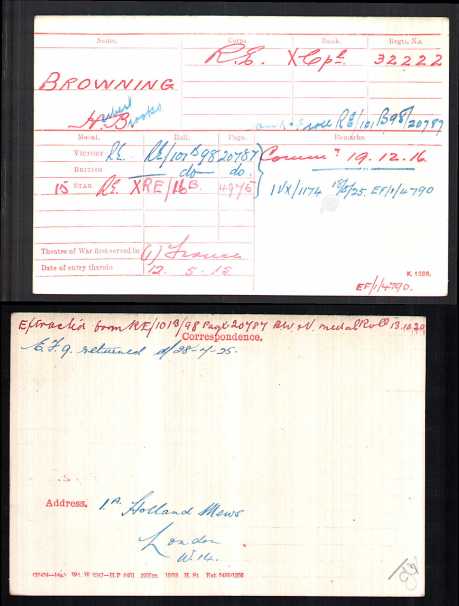
Bertie served in France during World War 1 – many thanks to Eton College’s archivist, Georgina Robinson for his war record. (See below).

Eton

His service number was 32222. From his enlistment records he was 5 feet 7¾ inches in height.

From the 1933 electoral roll, he was living alone in a flat at 8 Raglan Court, Raglan Gardens (now named Empire Way), Wembley Park.

It appears that in 1938 he was living in Brad House, Bradpole, Dorest, which is the address given on his travel record when he and Humfrey returned from South Africa on the Capetown Castle.

In the 1939 Register Bertie was recorded as living in military quarters in Barrack Road, Weymouth, working as a ‘civilian transport officer’, probably under the control of the RASC. Six civilian lorry drivers and a chauffeur were also living at the same address.

In December 1948, Bertie travelled on the Edinburgh Castle from Southampton to Cape Town. Final destination was ‘SR’ which is presumably Southern Rhodesia. His last address in Britain – not necessarily permanent – was a hotel in Dorking. So that may be from where he emigrated to Que Que, Southern Rhodesia now Zimbabwe.

He passed away on the 28th September 1959 in Que Que. His death notice was published in the The Times (London, England), Wednesday, 7th October 1959.

Bertie's Death Notice

His estate wasn’t settled until May 1964 – he left £3259 in England.

Below are other documents relating to Bertie’s during World War 1.

Bertie War Record

Bertie Medals


Chapter 15 Bambaie – Bangasson 222 miles 31 December 1938

Chapter 15

“Away to the east dawn was breaking as I drove away from the Shell agents. It was 5.53 and we had spent an hour and 3 minutes here, including crossing the ferry. I had allowed one hour, so my estimate was fairly correct. We were now 2 hours and 3 minutes late.

The Shell agent had warned us to be careful as there had been heavy rain and the road would be wet and slippery. Humfrey was asleep again as I drove off over the hilly road towards the Belgian Congo and I was not at all happy. Here the country changed completely. It was green and fertile with high rolling hills, a contrast to the burnt-up flat desolation of the district round Fort Archambault. The reason I was unhappy was that the track wound up and down exceedingly steep hills, generally with a narrow track that was wet and exceedingly slippery. I wasn’t happy. I seemed to be crawling but I daren’t go any faster. 40 mph felt like a hundred and the car skidded under the brakes in a most unpleasant fashion. Eventually I developed the correct technique for the type of surface and contour. Racing flat out in third up a long straight climb, I would go into top gear at the summit and get up to 50 mph. When half way down the other side a change down to third, gentle braking and into second reduced my speed to about 25 mph at which I felt content to cross the narrow plank bridge: then accelerate hard and into third again for the next rise. But it was worrying work on the slippery surface.

Humfrey sat up and yawned “What the hell are you doing, Bertie?” he inquired, mildly. “You seem to be changing gear every 100 yards.”

“Sorry,” I said “But the road is wet and damned slippery.”

He sat up suddenly at that and looked out through the windscreen. “Gosh,” he said, as we shot across another narrow bridge. Then, “I’m feeling fine now; like me to take her?”

“Yes, rather,” I said, and we effected he desired change. I had no desire to sleep now that it was daylight and we changed the seat into its upright position for day travelling. I leaned back, snuggling down on to the comfortable Dunlopillo cushions, and enjoyed watching Humfrey cope with the conditions. His tactics were the same as those I had employed but we did not seem to be making very rapid progress. I said “I’m afraid I’ve been awfully slow but I was frightened of the wet roads.”

“I expect it’ll be all right,” said he “I wouldn’t worry.”

“I’m not worrying, “I said, “I’m as happy as a king,” and I sang a little song. I have as much ear for music as a cow. Humfrey laughed. “Shut up, Bertie” he said.

Down a steep slope we went and came to a stream running between tree-lined banks. This is the Banqui, which swells into a mighty river before it joins the Congo, 700 or 800 miles away south, down near the west coast, though here, near its source, it is only about 100 yards wide. We were again fortunate enough to find the ferry on our side and quickly were put across to the other side. This ferry is operated in a very simple manner. There is a wire rope stretched from bank to bank and natives, standing in the canoes which form the floats for the platform, pull hand over hand on this wire and so propel their craft across. This ferry only delayed us 14 minutes from the time we stopped until we were away again.

When we got on the move, I consulted the log and found that, whereas we were allowed 2 hours 1 minute for the 93 miles from Bambari we had taken 2 hours and 9 minutes. We had averaged 34½ mph so I need not have been so despairing at the slow progress I was making over the early part. We had saved 6 minutes at the ferry on the 20 minutes allowed, so we were only 2 minutes down from Bambari, though actually we were now 2 hours and 3 minutes behind on schedule time.

I gave these figures as a sample of the kind of calculations that were going on continuously inside our car as we travelled across Africa, for on a journey like ours, this matter of time-keeping becomes as absolute obsession. While we were still in French Equatorial Africa it was a matter of some importance, too, for the ferries here do not function during the hours of darkness, as they do in the Belgian Congo, our next objective. We had only 150 miles to cover to reach Bangasson, the eastern frontier of the huge territory of French Equatorial Africa: in this 150 miles there were 3 ferries and as it was only 8.16 in the morning when we left the Bangui ferry we were quite safe in reckoning that we should be out of French Equatorial Africa and into the Belgian Congo long before darkness fell and the ferries stopped running for the night.

It is jolly country, this eastern end of the huge French province, green and fertile, with great rolling hills: it was pleasant to see once again trees that really looked like living things and not like ghosts of some long dead vegetation, with bare withered trunks and brown dry leaves. We enjoyed our drive over the comparatively sandy road through this pleasant country under the as-yet-not-too-hot rays of the morning sun. It was comforting not to be thrown off one’s seat every 100 yards or so and we felt it was a nice rest for our much-tired chassis.

63 miles on, we arrived at Fort Ombala – a name which Humfrey loves, he says that it reminds him of a thunder storm! – a large village on the banks of the broad River Kotto. The approach to this seemed different, somehow, to what we had expected. We were sure that the road had led through pleasant shady avenues where large native houses stood far apart and the office of the administrator, to whom we had delivered a letter from his offices at Bangasson on our return journey in the Rolls Royce, was a delightful thatched bungalow.

This road we were on seemed quite definitely to be bearing away and leaving the village far away to our left. It was obviously new, surfaced with deep red sand and with its path carved deep out of the red banks of earth on either side. It was not only new, it was exceedingly slippery so it was in a most cautious fashion that we descended to the river by the new Ombala bye-pass.

The Kotto is wide and lazy as it floats serenely between its tree-lined banks, and the blue water looked most tempting under the now rising heat of the African sun. It was seven minutes past ten when we arrived at the bank. We took a long 31 minutes to get across, when we left our log showed us to be 2 hours and 20 minutes late on schedule. We didn’t care much. The road was at least respectable, the country was pleasant, the car was running well, the sun was shining, though too fiercely perhaps! At Bangasson we should enter the Belgian Congo where the road, sandy but smooth, we knew to be better than anything we had found since we left the tarred road away back in Algeria. In addition, throughout the Belgian Congo territory, even though at fairly long intervals there are really comfortable hotels – at the one at Buta there is even a bar! -, there are telegraph offices (though cables cost a fortune), there are many places with white inhabitants; in a word, there is civilization, so we were eagerly looking forward to our arrival in that civilized country. We had no inkling of the tragic disaster that the Belgian Congo held for us.

On and on under the rising temperature as the sun climbed to its zenith and the thermometer inside the car rose to 100 degrees: through a big native village where the inhabitants gazed at us curiously, till we arrived at another ferry over the river Korro. They are an efficient lot, these natives of the Korro ferry and a cheery crowd to book, for they sang a cheerful song – after Humfrey had held up a 10 franc note with the magic word “Cadeau” – we were soon across in 17 minutes we were off again on the 11 mile run to Bangasson.

This is a large and important place. A big native settlement and the seat of the local administration, with fine white buildings in the native style, looking cool and clean with their reed thatched roofs and wide shady verandahs. It was very hot in Bangasson at 1.25pm and we fairly sweated under the brassy sky as we re-fuelled at the Shell agency. The engine appeared to need a little oil to bring up the level, so I attempted to remove the gallon can which we carried in clamps under the bonnet. After several tries, using large quantities of rags as insulators. I desisted. The can was far too hot to touch even through half a dozen thicknesses of rags! We therefore took a supply of Shell oil from the agency though it was thinner than the kind we were using. We felt that our good engine would not resent such a minor detail as the use of Double instead of Triple.

The re-fuelling completed we drove to the administration office to have our triptyque stamped on leaving French territory for Belgian. Humfrey went in while I sat in the car outside. Minute by minute the interior of the car, already like a furnace, grew hotter as the sun blazed down on the roof and I sat, dripping with perspiration. For half an hour Symons endeavoured to get away while the administrators to whom of course time was no object chatted away about the European situation! Humfrey is always polite under these circumstances: indeed, in my opinion, ultra-polite, though we always made appoint of making ourselves as civil as possible to all the officials and indeed to anybody else we met as we looked upon ourselves, in a very humble degree of course, as ambassadors from our own country to Frenchmen and Belgians. It would be better for the reputation of Englishmen and, may I add Englishwomen, if other travellers adopted a similar attitude for we have been told, in conversation with many of these most helpful dwellers in  far off places, the most grisly tales of the way in which they have been treated by people of our nationality. We have many times blushed with shame at these stories, told without resentment or rancour, of the ill manners of travellers. It is an attitude that I do not comprehend – this unpleasantness to foreigners (though in fact we are of course the foreigners in French or Belgian territory). Civility costs nothing – that is something more than a cliché and my experience is that there is nothing that anyone, Frenchmen, Belgian, Englishmen, or South Africa, white, black or brown, will not do to assist a traveller who appealed to for help in a civil friendly way. I do like to think that wherever Humfrey and I have travelled, we have perhaps left people with a better impression of Englishmen than they appear to have had before.

So Humfrey inwardly itching to get away but outwardly thrilled by the conversation of the French official, for half an hour while I remained outside sweltering in the sun and frenzied with impatience. At last he managed to excuse himself and to tear himself away. We drove down to the ferry across the great River Ubangi, already here, some six hundred miles from its union with the mighty Congo, a quarter of a mile wide – we found the interior of the car so appallingly hot that we took refuge under a tree on the river bank while awaiting the arrival of the ferry which is manned by natives from the farther, the Belgian Congo shore.”

Chapter 14 Fort Archambault – Bambari 335 miles 30/31 December 1938

Chapter 14

“We left Fort Archambault at 4.27, having stopped there 48 minutes, instead of our scheduled 19 minutes. This made me very cross because it meant that we were now 27 minutes late, and I hate to be late. We knew that our next stretch of 335 miles to Bambari comprised some of the worst roads we should meet with in the whole journey; but we were glad that we were to cover this stretch by night, because the country is monotonously uninteresting and we remembered the awful heat we had endured here in the Rolls Royce. Our schedule allowed us 11 hours for the 335 miles, that is 30 miles an hour and we looked forward to jogging quietly along through the night without any attempt to hurry. The track did not seem as bad as before, which was no doubt due to the superlative springing and general comfort of the Wolseley. We made very good progress until darkness fell and for some time after, but soon after passing Ndipi, 148 miles from Fort Archambault, we suddenly came to a barrier across the road. This was a wide piece of board, supported on two trestles: chalked on it were the words “Port detruit: route barrée”, and that was all. Nice! The bridge over a wide stream was down and the road was closed. Very nice indeed! So what does one do next? There were two obvious courses. One was to remove the barrier and proceed, hoping that we might find some way of circumventing the broken bridge: the other was to find some way of avoiding the obstacle altogether. We got out our French military maps and studied the matter. The result was not promising for the maps shows no other route from here to Fort Crampel. We had just established this fact and were contemplating an assault on the barrier when Humfrey’s luck, to which I have previously referred, came to our rescue. It didn’t look very promising at first, this bit of luck. It took the shape of a native, dressed in ragged trousers, an even more ragged pullover, and a battered hat, but it was really Humfrey’s good angel looming up out of the black night. The native approached the car, gravely raising his hat with true Gallic politeness. Humfrey addressed him, not very hopefully, in French, for neither of us speak a word of any native language. “Did he speak French?”  “Que, monsieurs.” (Humfrey’s Good angel!) He explained in broken African French that he was the foreman of the bridge-repairing gang and was at our service. Could we get over? Alas, not for many days would the bridge be passable. Was there any other way of getting to Fort Crampel certainly, we must go down this narrow track to our right for 40 kilometres, there we would turn sharply left and rejoin another track that would lead us to Fort Crampel.

That seemed sufficient for us. To find a bridge irreparably broken, to meet with the foreman who could speak a few words of French, to be told by him of a way of avoiding the broken bridge: all this is child’s play to Humfrey’s good angel and is an instance of the kind of providence that watches over its chosen. We were to meet with other instances of it in circumstances that meant the difference between life and death. But those circumstances were, at the moment, fortunately wrapped in the mists of the future. Thanking our good friend and bestowing upon him the largesse much appreciated by natives, a handful of my cigarettes – Humfrey does not smoke – we turned off down the narrow track to which he had pointed. It was no worse than the one we had quitted and we made good progress, running at a steady 35mph while Humfrey, having done his part by conjuring up the vision of the native foreman, slept serenely in the bed by my side.”

Bertie drove and finally he was delighted to come to a sign “and there fastened to a tree – oh joy of joys! was a dirty piece of board on which were chalked the words “Fort Crampel” and an arrow.”

“It always gave me an eerie feeling, this night driving; for with the long white path of the headlamps, shining ahead, the windscreen gave the impression that one was looking out at a lighted landscape from a dark room; inside the car it was inky black with only the faint yellow glow from the illuminated dials on the instrument board to make one realize that one was actually driving a car: dimly I could see, or rather sense, Humfrey’s recumbent form as he lay beside me wrapped in rugs. It seemed so  intensely lonely. There were no signs of life such as one sees when driving at night in England, dogs, cats and rabbits with, now and then, a belated pedestrians, cyclist or motorist. Here there was nothing, no sign of life of any kind, nothing. Only the night breeze raised by the car’s passage through the air and the steady whisper of the engine. Everything seemed very silent and it was hard to keep awake. There were no features to mark the passing of the miles; the scene was always the same as it rolled across the lighted screen of the headlamp beams. Eternal scrub and a few trees and more scrub: the yellow sandy track and the scrub. One had the illusion that one was not moving, that in spite of the evidence of the lighted speedometer dial with its hand pointing to 30mph,one felt that in reality the car and the eternal scrub were standing still and that when dawn broke, one would find oneself still in the same place”.

“As I was driving along, semi-somnolent and struggling with the desire for sleep, suddenly the trees receded and the line of telegraph poles ran across a little clearing. I was following them quite confidently, being convinced that they would lead me across the cleared space to pick up the track again on the other side. Then I got an awful fright. From the blackness of the car, a voice screamed out “Look out!” in a tone of horror and a vice like grip clutched my left arm. Heart in my mouth, I stamped violently on the brakes and brought the car to rest. “What is it?” I gasped.

Humfrey was sitting up beside me. “I’m most awfully sorry, Bertie” he said, “I must have been dreaming. I could have sworn you were heading straight for a great tree.”

“My God.” I replied, “You frightened me to death,” for my heart was beating like a  hammer. 

“I’m terribly sorry, Bertie,” he said. “I’ve never done such a thing before. I can’t think why I did it.”

I said, “I simply can’t drive anymore. I was frightened to death. Frightened to death,” I repeated stupidly.

“Here,” said Humfrey, reaching behind him in the darkness, “take a drink of this,” and he held out a cup of whisky. I drank it down but I was shivering so that I thought I was going to faint.

“I can’t go on,” I uttered.

“You must,” said Humfrey. “I promise you I shan’t do it again.” He was quite right, of course, though I was so shaken that I couldn’t see it. If I had given up that wheel then, I should never have been the same again while driving at night. The only thing to do was to go on now while the incident was still fresh in my mind and drive through the nervous attack bought on by the sudden shock. After a well known racing driver had had a narrow escape from death while practicing at Brooklands, a wise friend forced him to get into another car immediately and do five or six really fast laps and though his shattered nerves cried out against this brutality, his friend was right. After completing his fast laps, he regained his confidence and the narrow escape never affected him again. The well-known racing driver was the late Comet Zborowski and the wise friend that old hand, Lionel Martin. The story is well-known to all Brooklands habitués. So Humfrey was right and, with quivering nerves, I went on driving. For a short time Humfrey sat erect by my side, but when he sensed that I had recovered and was no longer shaking with apprehension, he quietly lay down and, when next I gave a thought to him, he was sleeping like a child. I never thought of the incident again but the experience was an unpleasant one. Desire for sleep had gone and I quite enjoyed the driving. We never attempted to do anything but crawl during the night hours when one of us was asleep, content with the knowledge that the miles were slipping away behind us and this quiet night driving would have been really pleasant if it had not been for this awful battle with the desire for sleep. We realized now, for the first time, what an immense additional strain we were to undergo, owing to the fact that when one of us was sleeping the driver had no one to talk to. A third driver would have made all the difference as two would have been awake while the third slept. We had, in fact always when discussing an attempt on the Cape Record contemplated having three drivers for this very reason, but lack of space and the wish to save the additional, not inconsiderable, weight had forced us to abandon the idea for this run. The lack of a third driver was to prove a very heavy additional strain on our nerves throughout. But it was unavoidable”.

Bertie handed over to Humfrey and slept like a log. The detour had added 29 miles to their journey.

“Before taking over from Humfrey, I took a glance at the log to refresh my memory because I remember that at a place called Moronbas, we had on a previous trip been in some doubt as to which track to follow, as there was a fork with no sign. I wanted to be sure now far ahead this place lay. I can only say that I never saw it. Whether we were following a different track, I don’t know, but the one we were following did not agree in any particular way with my recollection. However, I arrived at a T road and found an immense sign board on which, among the names, I was able to pick out Bambari, though as I swung round the corner I was not able to see how far away it was. I did not want to stop unless I could avoid it, as I have learnt by experience that to stop the car almost invariably causes a sleeping passenger to awake. I wanted Humfrey to stay asleep. Several times after this, the track turned or joined others and I followed blindly a series of these enormous sign boards, on each of which I discovered as the bottom name the word “Bambari”. At last, I came to one facing me so that as the headlamps illuminated it some 200 yards ahead I as to get a good look at it. It said Bambari 50; that meant 50 kilometres or about 31 miles. It was now four o’clock in the morning, so we should be in Bambari by 5. I couldn’t remember what time we were due there and couldn’t really be bothered about it. All I knew was that another hour would see us there. Soon it would be daylight and another of these torturing nights with its amazing longing for sleep would be over”.

 “Suddenly the track sloped steeply downward and rounded a sharp bend to the right. Oh yes, I remember this. It was called in the log “Steep descent” and as I braked for the corner, Humfrey woke, sat up, yawned, and asked the inevitable question “Where are we, Bertie?” he said. “About 25 miles from Bambari,” I said. “O.K.” he replied, “are you all right? If so, I shall go to sleep again.”

Bertie had ‘beastly doubts’ that they had strayed off the track and then they may have insufficient petrol to get back and reach their next refueling station. As he said – “Ugh! These worries frayed the nerves and gave us moments of acute and quite unnecessary misery.”

They eventually found the track and checked “The dashboard clock said 4.50 and the log told us that we were due here at 2.50 so we were 2 hours late: ½ hour late leaving Fort Archambault, say an hour for our discussion with the foreman and the 29 miles detour: this meant that we had only actually lost ½ hour and this was due to our slow speed through the night.”

They had arranged with the Shell Company that they would be re-fueling at 2.50 in the morning and they were wondering if the instruction had arrived from England. They stopped on the river bank with the Wolseley’s headlights throwing a powerful beam across the river and woke the sleeping crew of the ferry.

“They had been sleeping in their canoes awaiting us. It was a triumph for our organization and for that of the Shell Company. We drove on to the ferry and set off for the farther bank, blowing several lusty blasts on our twin horns to warn the Shell agents that we were coming.”

Once they drove off the ferry, they found the Shell pump and were greeted by a young Frenchman who had been waiting since 2am for their arrival.

“We told him that we were sorry to be late and thanked him for the arrangements he had made for the ferry. We refilled our tank while the Frenchman kindly produced for us coffee and biscuits. Then I spied a jug of water and at our request he bought out a large basin. We stripped off our shirts and had a much needed wash, the first we had had since leaving Marona 1000 miles back.”

Keeping in touch

Hi to the Cape Record blog readers.

I can see that there are many people from all over the world having a look at the blog and I’d love some feedback about how you are enjoying Bertie’s diary. I’m busy with Chapter 14 Fort Archambault – Bambari 335 miles 30/31 December 1938.

You can email me at cwilkin@iafrica.com

Capture

Chapter 13 Masona – Fort Archambault 384 miles 30 December 1938

Chapter 13

“I slept like a rock for an hour after we started, as Humfrey had another hour’s driving to do, and afterwards he slept while I drove steadily on in the darkness over rough track. The character of the country was now changing from the Cameroons with its plentiful rainfall induced by the lofty peaks of the Cameroon mountains and its ample vegetation. We were now to enter that bleak desolate region known as the French Equatorial Africa, a huge bare country stretching for 800 miles from east to west. And the character of the road, or track, alters also. In the Cameroons the surface is mostly comprised of earth, soft and yielding, but in French Equatorial Africa it is hard, rocky and appallingly rough. The tracks in French Equatorial Africa are as bad as, or worse than, those of any other parts of the journey from Algiers to Cape Town and one is liable, unless one is cautious, to break something at almost any minute by hitting rock or gully in some inattentive moment, so the watchword was caution.

It was 5.25 in the morning, and still dark, when I pulled up on the bank of the great Logone River, a mighty stream that rises far away in the mountains, 800 miles to the south, and eventually discharges into Lake Chad, 150 miles to the north, that swamp like lake that has no outlet to the sea. The Logone River is a sluggish stream, wandering through almost flat country and at Bongor its width would be about a quarter of a mile.

Humfrey awoke as I stopped the car and we stared across the river at the village lying on the far side. Not a light was to be seen and it was obvious that we were too early. It was 5.25. Humfrey suggested trying the horn and the headlamps, so for some minutes I blew piercing blasts on our twin horns and switched on and off our brilliant lights. There was no result and the village lay black across the river.  At last away down to our right, we saw this sparkle of flames which soon revealed itself to be a blazing fire. Once again I tried the horn and lights, with no result. We had hoped that someone, hearing the noise and seeing the lights, might call the crew of the ferry but the village lay wrapped in darkness, except for a few dim figures that we could see against the flames of the fire.

At last we became philosophic. It was clear that nothing was going to bring the ferry across for us until the crew considered that their working hours had commenced so we decided to employ the time by having breakfast. We made a hearty meal in the growing light of day, occasionally breaking off to send a few more rousing blasts on our horn across the silent river. Breakfast finished and packed away, we sat staring at the village. It was now full daylight and just as we were beginning a new assault with our horns we saw signs of life down by the stream, but in a place quite different from where we had expected the ferry to put out. We watched eagerly and at last it was clear that this was the ferry boat’s crew launching their craft. Soon we saw the crazy affair creeping slowly across sluggish water towards us and as it drew nearer we recognised it. We recognised the “Capitaine” a native who wore the same ragged blue trousers, the same tattered brown overcoat, and the same solar toupee as when we had passed here two years before! We recognised too, the colossal four-cylinder outboard motor which projected far out over the stern.

This ferry, except for the outboard motor, is typical of all the ferries in Central Africa, so one description will do for the lot. It consisted of four or five dug out canoes, wooden logs almost 60 feet long, pointed at the bows and square at the stern, the inside hollowed out by fire. The canoes are fastened side by side to a wooden platform resting upon them across their width: this platform being about 20 feet long and eight feet wide. And that is all. The crew stands in the dugout canoes and propel their crazy craft by means of paddles, one of them usually giving the time by means of a chanted song. The crews vary considerably in temperament: some are light and merry, chanting in unison and laughing like happy children, others are somber and rather miserable-looking. The Bangor crew were a gloomy lot and the “Capitaine” a born pessimist.

As they slowly drew nearer, for the river, though seeming to be sluggish has a considerable current and the journey takes a long time; we saw that the outboard motor was not motoring. “Ah” we said laughing, “he’s up to his old ticks again,” for when we crossed here before, the “Capitaine”, in response to him to start it has made signs that he had no oil and it was not until we had supplied him with some of our spare oil that he would start his motor going.

At last the ferry arrived at the bank and the crew, began to hoist up the precarious plank access on which one has to drive onto these ferries. When all was ready, Humfrey drove the car on and we found at once that with our high ground clearance, we had no anxiety about anything. The difficulty is that the slopes down to these ferries are so steep that when the front wheels mount the planks, the tail of the car is apt to strike the ground with a tremendous bang. Almost every time we drove the Rolls Royce on to or off one of these ferries, the tail of the car, beneath which was the exhaust fishtail, used to strike the ground, until eventually the fishtail was so flattened that there appeared to be no egress for the exhaust at all. Our Wolseley’s steeply cambered springs completely obviated this trouble and by degrees we became utterly careless how we drove on and off the ferries. As I anxiously watched Humfrey driving on to this first one it was amusing to see the huge tyres flatten when they came to the cross baulks of timber on the staying, roll themselves lovingly round them and clamber over them. I saw for the first time how much, from the point of view of absorbing shocks, we owed to these tyres and their enormous capacity for swallowing obstacles.

The natives pushed off from the shore and began to paddle. When we pointed to the motor and signed to the “Capitaine” to start it, he shrugged his shoulders and patted the oil tank. We burst out laughing and apparently that made him recognize us, for though he did not manage to raise a smile to his saturnine countenance, he gravely shook us each by the hand. We handed him a tin of Shell oil and, winding a strap round the flywheel, he set the motor going. It was a colossal affair and must have been at least ten horse-power. He dipped the whirling propeller into the water and the ungainly craft shot off at redoubled speed while the paddlers ceased their efforts. Eventually we came alongside and disembarked up a similar narrow plank gangway. The charge at some of these ferries is 10 francs while others are free, in which case one is expected to give 10 francs to the “Capitaine”, so the result is exactly the same whether it is  a free one or not! In addition, we always used to give 5 or 10 francs as a present to the crew. Humfrey would hold up the note so that they could see it and say “Cadeau”. This is a word that they all understood and while the gloomy crews would raise a difficult smile the cheerful ones would burst into a merry song, calling out “mercy monsieur, mercy monsieur.” When we landed, a native soldier saluted and came forward. He climbed on the running board and signed to us to proceed to the Customs House. Humfrey and I had often discussed what would happen if we decided to rush the Customs here, to avoid delay. Suppose that, instead of stopping to pick up the soldier, we were to drive straight off! We were pretty sure that his rifle would not be loaded and, if it were, we were equally sure that he would never hit the car. It was least half a mile to the Customs post from the river and long before he arrived there, we should be past. Bongor is not in telegraphic communication with any other place, though the T.S.F. (Telegraphic Sans Fil – or wireless) was expected to be installed shortly. Well, how would they do anything about it?

It was five minutes past seven when we left the ferry and 7.28 when we got away from the Customs Post, after exchanging the usual remarks when the official noticed with blank astonishment the date of our entry at Algiers. “Messieurs, is it veritably the fact that you did not leave Algiers until the 25th December?” We assured him that it was so “And it is now the 30th December?” We reassured him on this point. “My faith, it is formidable, Formidable!” he would utter, looking at us if he doubted our very existence. This little scene became so familiar to us that we ceased to take any notice of it after a few repetitions, but it was a measure of the amazement created by all out record breaking passage through Africa. We had expected, according to our log, to leave Bongor at 6.30 so we were just an hour late, owing to the dilatoriness of the ferry men.

Bongor was a desolate, gloomy spot only redeemed from sheer ugliness by the neat river Logone that sparkled under the early morning sun like a neat silver ribbon. It is dry, arid and hot. The stunted trees and dried-up vegetation give no shade or air of coolness. I should not like to be an official stationed at Bongor. The natives were a wonderful crowd, most of them, women and men alike, seem to be about six feet tall: they are completely nude except that some of them wear a small piece of string under their waists and the women smoke short pipes. They do not seem a very nice people, as they are inclined to be solemn and uninterested.

It was already hot when we left Bongor by the wide straight sandy track that was beside the great river. The surface of the first part is quite good, though the dust clouds we left behind were terrible – our big soft tyres were demons for raising dust, as we had notice before – and for sheer decency’s sake we felt compelled to slow down for the numerous native villages through which we passed to avoid obliterating them completely. The population in this neighbourhood appears to be fairly plentiful and the country is cultivated for a mile or so on each side of the villages, but it is not an agreeable part of the world. After 94 miles from Bongor, 2 hours and 27 minutes, we had averaged about 38mph and here we had decided to make a deviation from the track we had followed in the Rolls Royce. Our maps showed another track cutting off to the left and joining the one we had previously travelled about 100 miles from the Customs officer at Bongor as to the practicality of this route and we had decided to take it as it saved 30 miles. We found, in fact, that it was no worse than the other and we made quite good speed. The heat was terrific and we were both getting rather peevish when Humfrey gave me an opportunity to vent some of my wrath. The track we were following was comparatively straight when suddenly there loomed up before us a right angled, right-handed bend. It was plain to me that this bend was deep in loose sand, and exceedingly sharp, and that it was quite impossible to get round it at the speed at which we were travelling, some 45 mph. To my unutterable astonishment Humfrey made no move to slow down and we skidded round it in a huge broadside which carried us within inches of the rough bank at the side and which bought my heart into my mouth. I let fly in some of my choicest language and Humfrey retorted in kind. Finally, after some terse exchanges, we simultaneously burst out laughing, and having recovered, Humfrey explained that he simply had no idea why he attempted to get round that corner at an utterly impossible speed. He assured me that he was not sleepy, that he had seen the turn miles away, that he could see it was deep in loose sandy gravel and that, in fact, he had made a bloody fool of himself. After such a hands on admission there was, of course, no more to be said and I think the incident really did us both good. I may add that through the whole of our journey this was the only time Humfrey did a foolish thing and it was the only semblance of a mistake he made in an amazing exhibition of absolutely perfect driving. If one considers that a possibility of making a mistake arose perhaps five times in a mile and that he drove some 5000 miles of our journey to Cape Town, only to make one mistake out of all these opportunities argues a performance which, in most drivers, would be nothing short of miraculous. But not in Humfrey, who is the complete and finished perfect driver.

We plodded on through the uninteresting barren country that is French Equatorial Africa under the blazing heat of the midday sun. The thermometer inside the car was standing at 102 degrees. We were delighted with the green celluloid strips across our windscreen for through the narrow slit between them we could look ahead without screwing up our eyes, but when one looked out of the side windows the whole countryside seemed to be white-hot and burnt colourless in the blinding glare, so that it seared the eyes to look at it. Though we were continually longing to drink we pursued the policy on which we had decided at the start and which we had been advised to observe, the policy of not drinking at all while we were on the move. For it is quite certain that the more one drinks the more one wants to drink and the act of drinking does nothing to assuage one’s thirst but only gives one a momentary gratification of the senses. Occasionally we would eat an orange, the passenger at the moment feeding the driver with quarters and we would suck acid drops, which really quench one’s thirst, at any rate, for the moment. We felt no inclination to eat and indeed only ate to order, so to speak, as a means of keeping up our strength. It is for this reason that I have made no mention of stops for lunch: on rare occasions we would perhaps consume, while still travelling, a tin of fruit, but the contents were usually so warm that any refreshment we might have obtained from them was lost. More and more as our journey proceeded; we cut out any thought of food during the day and only ate either in the early morning or after the sun had set. We were hardly hungry but always thirsty.

As we went on, we found that the steering was again getting stiff and the car again losing its automatic sense of direction. Eventually this became so bad and so tiring that we decided to stop and try the grease gun. It was about 2.30 in the afternoon, the very hottest part of the day, and as we stopped a great wave of heat rolled over us so that every breath scorched the lungs, for with the cessation of forward motion the draught we created by our movement stopped and we felt the full force of the blazing African sun. Even now I can feel that searing heat and see the picture of our car standing in the wide sandy track, the low scrub colourless and withered by the white hot rays of the sun, and Humfrey lying beneath the car while I handed him rags and the grease-gun. He found it impossible to get and grease through the lower nipple on the off side steering post, so I filled an oil gun with oil, already hot, from the spare can under the bonnet and he squirted this all over the steering connections, hoping that some of it would get to the dry place.

Then, quickly replacing oil and grease guns in their clips under the bonnet, we set off again, gasping for breath and steaming with perspiration. It was a relief to be on the move again after our ten minutes stop and particularly as, suddenly, the steering grew light again and the car would retain its direction without continually hauling it straight.

Just after three o’clock we reached another ferry and were fortunate enough to find canoes on our side of the stream, so that in little more than a quarter of an hour we were across and away. We seized the opportunity while crossing to climb down into one of the canoes that form the support for the platform and to splash the water over our faces and arms. It was not easy to make a decent job of washing one’s face because it was quite impossible to remove one’s solar toupee for an instant for fear of sunstroke but at any rate the cool water gave us momentary gratification and we felt cleaner. It wasn’t necessary to dry faces or hands for the sun did that for us almost instantaneously and the rapid evaporation brought a sense of coolness, – for the moment.

Just after leaving the ferry, we had our first encounter with a swarm of locusts. At first we did not realize what the few flying insects were as we had never seen them before, but suddenly we saw in front a black cloud and simultaneously exclaimed “Locusts.” Hurriedly we shut the side windows as we approached the swarm and, as we rushed through them at 40 miles, an hour it was like a hail of bullets striking the windscreen. We were almost afraid that it would break and so thick was the air with the flying bodies that it was difficult to see where one was going. Suddenly the air cleared and the banging against the windscreen ceased. We were through for the next few miles. We were thoroughly amused by the antics of some fifty or sixty locusts that were left on the bonnet. Clinging to the louvers on the top, they would be whirled round by the current of air created by our passage and suddenly one of them unable to retain his hold would go skidding along the smooth central ridge between the louvers. Sometimes he would manage to cling to another louver or body of one of his pals, and sometimes as he went spinning along he would sweep other locusts from their hold, so that a dozen of them would come whirling along the smooth metal to be swept of sideways when they struck the vertical windscreen. It was five miles or more before the last was swept away by the wind and we laughed heartily at the involuntary antics by our visitors. When we stopped at the store at Fort Archambault, 13 miles beyond the ferry, there were locusts stuck in every crack and cranny of the front of the car: the radiator was covered with them and as there was no way of getting at them through the grille in front, we had to leave them there.

We arrived at the Portuguese store which was the Shell agency at Fort Archambault at 3.39, out schedule time of arrival being 3.41; so we were exactly 2 minutes early after a journey of 4200 miles! We were quite proud of that, as we take a certain pride in keeping to schedule. We had come 4274 miles from England in less than 8 days, averaging about 550 miles per day, and we had averaged over 600 miles per day from Algiers. We were now 820 miles from Kano, and it had taken us 33 hours to cover this distance, but out of this time we had stopped ½ hour at Mora for the customs, 6 hours at Morona and had wasted 2 hours at Bongor through being too early for the ferry. So our sum time had been 24½ hours, and we had averaged 33½ mph

We refueled our tank from 50 gallon barrels. This is a laborious process as it entails decanting the spirit into 4 gallon tins and pouring these into the tank. While this was being done by a horde of natives, we went into the store and consumed large quantities of cold lemonade. The oil refrigerator is the greatest boon that modern invention has brought to dwellers in the tropics and makes the difference between life being bearable or utterly insupportable. Linked with the oil refrigerator, I should place the wireless: not so much for the purpose of entertainment, though this phase is of course of value, but as a means of communication. Think what it must have meant to a place like Fort Archambault. Previous to the coming of the wireless, it meant that an addressed letter to France would have to be carried partly by native runner, partly by canoe where a river was available for more than 6000 miles to reach the coast, which might or might not be in cable communication with Europe. Even, if it were, it would probably mean at least eight months or more before a reply from the home country could be received. The wireless now brings the home country within a very few days of the centre of tropical Africa. A few days? A few hours, perhaps you think! Wait and you shall hear.

Leaving me consuming cold drink at the store and talking to a Dutch chap and his sister, who were touring Africa in their Ford and were duly amazed to hear that we had left Algiers 5 days before; Humfrey went off to find the Port Office as he felt he must cable news of our progress to Thomas at Wolseley’s. In twenty minutes or so he returned, grinning broadly, and told me what had happened. He had asked the French post office clerk if he could cable to England: the Frenchman was aghast. “Monsieur,” he said, after consulting tariffs, “it will be very expensive. It will cost you 57 francs a word; six shillings certainly did secure a lot, but Humfrey said “I can’t help it. I must send a message even if it is only six words.” So he set to work to write out the message. But the frugal mind of the Frenchman apparently revolted at this waste of money and, after a struggle, his natural native economy triumphed. He came across to Humfrey and said “Monsieur, I cannot see you waste your money. This cable will take many days to reach England. It has to be relayed may times and there are often long delays. Now tomorrow morning an aeroplane bound for France is passing through here and you can send a letter by this for say few francs which will reach England at least four days before your cable.”

Humfrey decided at once not to send a cable and as he felt that to write  a letter would mean that he ought to write a long one, he decided to do neither and he returned to me at the store without having communicated with Thomas at all. As it happened, this was unfortunate in the last degree, but we had no suspicion then of the disasters that were to befall us in the near future.”