Chapter 28 – More Difficulties

We were called at 5 and at 6.15 we left Kapiri M’poshi, with pleasant memories of a comfortable jolly little hotel. We were in good spirits and felt very fit. At last, the poisoning caused by the mixture of artemisinin and the drug I had taken at Nairobi seemed to have been expelled from my system and for the first time I felt something like my own old self. The sun shining in a cloudless sky may have had something to do with our improved spirits: anyway, we felt thoroughly cheerful as our good Wolseley sailed over the excellent road towards the South. Our host had told us that the road was good as far as Broken Hill but had warned us to be careful of a dangerous bridge which lay in wait round a corner at the end of a long straight. But he had not specified exactly how far this bridge was from Kapiri M’poshi, so that each time the road curved we slowed down cautiously. We crossed several bridges over streams and at last concluded that me must have meant one of these, though we had not seen any particular danger in any of them. The rain of the day before seemed to have bound the road surface into a solid hard surface and we were sailing gaily along at about 50 miles an hour when the road took a gentle left-hand curve. As the road straightened, we saw what was undoubtedly the dangerous bridge before us, and a nasty looking affair it was. The road sloped steeply down to a river and crossed it by a wide plank bridge with no guard rail of any sort, and the road itself was deep in slimy mud, for the sun’s rays had not reached it owing to the shade cast by the forest bounding the road. Humfrey braked and the tail of the car slid round: he released the brakes to straighten the car, but it was obvious that we were travelling far too fast to cross the bridge with any degree of safety. He braked again and made a lovely snap change down to third while the tail of the car was sliding: an instant later he managed to get down to second gear and this helped to steady the wildly skidding car and to slow it down. The bridge was horribly near, and we were by no means facing straight for it as the tail of the car swung from side to side on the slimy treacherous surface. At least, just at the last moment when I was beginning to visualise a real whole-hearted smash, Humfrey got the car under control and we dashed across the wood planks. I had a glimpse of racing water twenty feet below: then we were across and rushing up the opposite slope which was equally slippery. We had no trouble in climbing it because the impetus of our comparatively high speed, probably about 30 mph, carried us some distance up it and the engine was well able to cope with the remainder. When we reached the top, we looked at each other and laughed. I said, “Well done, Humfrey” and he replied “Nasty, wasn’t it?” It was at a more sedate gait that we continued our journey but we ran into Broken Hill without further incident, having taken an hour and 13 minutes for the 39 miles. A lot better then yesterday!

Broken Hill was a delightful surprise. I had heard of it as a mining centre and had conceived in my mind’s eye a composite picture made up, shall we say, of the Rhondde Valley and one of those ghastly mining villages of the worst part of Yorkshire. Instead, we found a pleasant smiling township with wide streets and broad expanses of green grass around which were, sparsely scattered, the fine residences of the local gentry with the delightful airy spaciousness of a country where land is cheap and where buildings do not have to be crammed tightly against each other.

We had decided to breakfast here – we had only had a cup of tea before leaving Kapiri M’poshi – and while breakfasting, to have our car thoroughly greased and checked over. We found an excellent garage and set them to work while we sought the hotel. The large panelled dining-room was pleasant with the early morning sun pouring in through its open windows and as we looked out across the wide park-like meadows in front we felt that fate might hold worse things than being compelled to pass one’s days in Broken Hill. We were shown to a bathroom, to reach which we were conducted out at the back of the hotel where bedrooms were built round a garden of flowers with a fountain playing in the middle. A delightful spot, this hotel at Broken Hill.

We dawdled lazily over a hearty breakfast and Humfrey, having spotted a photographer’s shop, went out to buy a camera as he feared that his own cameras had suffered from the ducking they had received when they had lain under-water for 12 hours. It was for this reason that we brought back so few photographs of the portion of our journey between Juba and Broken Hill. He felt it was a waste of time to take photographs with a camera that was not working properly. He later discovered that his small “Retina” was in perfect order, and we regretted particularly not having any pictorial record of the crossing of those fantastic swamps where the tall grass grew all across the road a foot above the level of the radiator.

We wasted a lot of time at Broken Hill but we were content to laze a few hours in the pleasant sunshine and it was not until 10.13, after a stop of nearly 3 hours, that we set off on the road to Lusaka 91 miles away. The road belied its early promise, so that it was 1.15 when we drove into this growing town. Lusaka is the new capital of Northern Rhodesia. It having been decided to move the seat of government here from Livingstone, as it had been found that this was not sufficiently central. I have no doubt that the new part of Lusaka where the government buildings are and which lies away to the left of the through road is pleasant enough, but the parts that we saw resembled nothing so much as the pictures of early American townships. It was a jumble of corrugated iron and wooden shacks, with broken bottles and old tins forming prominent features of the landscape. We stopped here at a modern-looking garage, which was on our list as being a Morris agency, as we wanted to get a small repair job done. The two rods which stay the radiator cowling to the dash and which had been broken in the crash had been welded at Nairobi. They had now broken again, and this had left the radiator cowling free to work backwards and forwards at the top; so that we found some difficulty in persuading the bonnet to stay in place as it was only held by one broad strap since the fixing clips had been torn away in the crash. Also, these rods annoyed us by rattling on the metal of the dash and we felt that we must try and get them repaired. We found that we had unfortunately arrived at lunch time and the repair shop would not be open again until 2 o’clock. We did not want to waste more time so we contented ourselves with tying rags round the broken ends of the rods to stop them rattling and went on.

Outside Lusaka, we bore to the right and came on a most unpleasantly slippery piece of road. It ran on a sort of causeway above the surrounding marshy land and it was covered with a particularly glutinous and slimy film of mud. I had quite a struggle to keep the car from sliding off the causeway into the fields below. About 5 miles out we came to a definite stop. Across the road ahead was a barrier and a notice “Bridge down. Road closed.” There was also a signpost pointing down a road to the right which said “Chilongabonga” or some such word. We consulted a map and Humfrey said that was all right, that it was on our road though it did not appear in our logbook. So we turned off and slithered along for another 5 miles or so. There were various roads turning off which appeared to lead to farms – indeed we saw a car ahead turn away down one of these. Suddenly, without any warning, our road deteriorated into what I can only describe as a combination of a river bed and a cattle track! It was deep in red mud and ran between high banks of earth. There were no tracks of vehicles on its surface, no marks at all except the hoof marks of cattle. We didn’t like it and as it grew narrower and narrower we liked it even less. It in fact, it was quite plain that something was wrong. This was not a road at all: it was a cattle-path leading to some farm.

There was nothing for it to turn back. It wasn’t easy. The track was very narrow, not much wider than the length of the car and the surface was deep and soft, so that while I moved gingerly backwards and forwards I was in terror lest the wheels should begin to spin and we should get stuck. Gentle manipulation of clutch and throttle managed it at last and I drove slowly back along the slippery road. As the road, which was apparently the one we wanted, was closed for a broken bridge Humfrey decided that the only thing to do was to return to Lusaka, get our broken tie rods repaired and find out if there was any way of circumventing the broken bridge. I hated going back along that slippery causeway, but it was so obviously the wise thing to do that I submitted, though with ill grace.

We found the garage open now, for our little tour down the cattle track and back had occupied about three quarters of an hour. The manager, a keen young fellow, himself undertook to weld new ends on to our broken rods and meanwhile he telephoned to the local civil engineer about the broken bridge. The reply was consoling if annoying. It was “Oh yes, the bridge is broken but a way has been made for a car to get down the bank and ford the stream. No. He was sorry he didn’t know about the “Road closed” notice which was still there. He though it had been taken away. Humfrey and I looked at each other. We wondered what we should have done if we had arrived at this “Bridge Down” notice in the middle of the night when there was no one from whom to make inquiries. It was funny that, that thought should have occurred to us, because in the early hours of the next morning we had that very problem to solve! Rhodesia in the rainy season is a nice motoring country! It is certainly rarely dull!!

It was not until 3.35 pm that we finally got away from Lusaka, the radiator stay-rods having been repaired. It was 2 hours and 20 minutes since we passed through it for the first time on our little excursion along the cattle track and once again, we drove along that slippery causeway which we had come to hate exceedingly. We drove boldly around the “Road Closed” notice on the pass and continued. In a mile or so we came to a stream with its bridge washed away. It was not a serious obstacle. A track had been cut in the bank and we drove down this, forded the stream on a bed of logs laid in the water, climbed up the bank on the other side and regained the road.

It was a pleasant country through which we drove after leaving Lusaka, well-wooded and friendly looking country, and the road wound in gentle curves around the shoulders of little hills. The surface was dry, hard, and not too bad. Perhaps the weather was a trifle too hot for the sun blazed down from a clear blue sky but even overpowering heat was preferable to the ghastly downpour we had driven through the day before. We had no anxieties, though we were disappointed at our slow progress since we left Kapiri M’poshi that morning: we had spent more than 5 hours at Broken Hill and Lusaka and had only covered 130 miles. Nevertheless we were not worried and after our exhausting struggle with bad roads and worse weather the day before I think that our leisurely progress that morning probably did us an enormous amount of good.

The next point in our log was Kafue River, where there was a ferry which, we knew, only ran during daylight hours but we had no anxiety about that. It was still early afternoon when we had left Lusaka and the ferry lay only 37 miles away. Eventually we arrived on the riverbank at 4.52, having averaged exactly 30 miles an hour from Lusaka. There used to be a bridge over the Kafue River some six or eight years before it had been carried away by unusually heavy floods and since then the crossing has been carried out by a native ferry. It has not been thought worth while in view of the paucity of through traffic, to rebuild the bridge. It only took 16 minutes to cross the river, a fairly considerable tributary of the great Zambezi, and I only remember it because of the intense heat that surged up in great waves around us while the car was stationary. It was bearable while we were on the move and the heat-proofing of the Wolseley double bulkhead system was perfect. Never at any time did we feel any heat or suffer from any fumes from the engine, even though we passed through abnormally high temperatures. Yet one remembers certain cars which are almost undrivable in warm weather even in England because of the appalling heat of the driving compartment. The road remained reasonably good and we made good time to Mazabuka. We had intended to stop here for dinner and to drive straight through the night, for our morale had completely recovered and I personally was feeling quite well again. Humfrey had always been ready for a night drive, with the possible exception of the night at Mbeya after our nerve-shattering journey over the slippery mountain pass. He had, however, realised that I was quite unfit for the fatigue of a night drive and had wisely suggested stopping each night. It had been a sad waste of time but the soundness of his judgment was shown by the fact that, although our days had been fairly strenuous ones, I had now completely recovered. There was a nice looking little hotel at Mazubuka but as it was only 6.35 when we passed it having coveraged 31 miles an hour from Kafue River, and it was not yet dark, we decided to go on. It was only 67 miles to Pemba where we had had reports of a good hotel and if the road remained as good as it had been we should be there soon after 8.30, not too late for a meal of sorts.

We were to meet with a sad disappointment. Less than a mile from Mazabuka we were sliding about on villainous black cotton soil of the very worst type!  We agreed that it was probably only a short patch, probably caused by the fact that we appeared to be crossing a swampy track. For five miles or so we skidded violently from side to side as we crawled along over the vile black slime, and if it had not been for our good knobbly tyres I am sure we should have slid bodily off the road altogether. As it was, it was a terribly slow business. Ten miles an hour seemed a racing speed and our visions of dinner at Pemba began to recede into the dim distance. After about five miles we met another car and the driver signalled to us to stop. It was a Ford and we noted that he had chains on his rear wheels. He leaned out of his window and “You can’t get through,” he called. “I’ve been bogged for an hour and have decided to turn back.”

We looked at each other and the same thought was in both our minds. “Thanks very much,” answered Humfrey, “but we’ll go and have a look at it, I think.” We drove on. We were not going to admit defeat without a struggle: we believed that our Wolseley could get through anything with the possible exception of water over the radiator and our friendly adviser had only spoken of being bogged. We went on. The road was no worse and no better than it had been for the last five miles until at last, just after darkness fell, we came to a really bad bit. The black soil seemed to have no bottom and we waltzed and curtsied as the tyres skidded and spun in the bottomless stuff. Two yawning chasms opened before us as we slithered sideways along that detestable road. “A Graveyard” we exclaimed with one breath. With a great effort Humfrey managed to avoid the great holes where our friend had stuck, for under these conditions a car always evinces an insane desire to follow the course of its fore-runners and drive into the holes it has made. We sidled ungracefully past the danger spot and crawled along. We’d got further than he did, anyhow, and we did not relish the prospect of going back. After all, if the worst came to the worst, we had plenty of food in the car, could sleep comfortably in our beds in it, and dig ourselves out in the morning.

We went on and gradually the road improved. It was still dangerously slippery but the danger points were now more in the nature of mud holes than of continuous slime. At last, the road began to rise slightly and as it rose the surface definitely improved. The black cotton soil disappeared and ordinary yellow mud took its place. We began to hope that the worst was passed and that we had left the swamp behind as we climbed onto higher ground.

At nine o’clock we drove into Monze, a small township clustering round a railway station and, to us, a railway station seemed to betoken the end of our journey. No longer for us the wild solitude of French Equatorial Africa or the forest belts of the Congo, but a journey through civilisation, the beginning of the end of our struggles. A railway station seemed so very homelike, stable, and solid.

It was nine o’clock when we reached Monze and it was clear that dinner at Pemba, 23 miles on, was a dream. People go to bed early in these parts and it was hopeless to expect a meal at 10 o’clock at night: 10 o’clock if we were lucky with the road, 11 o’clock if we were not! You see, we had grown humble in our estimate of probable average speeds! Before that stretch of black cotton soil we had reckoned an average of something over 30 miles an hour respectable, now we were contemplating an average of 23 or even half that as a possibility! The reason for this sudden access of humility was quite simple. The 44 miles from Mazabuka to Monze had taken us 2 hours and 25 minutes! 18 miles an hour!

Humfrey said, “We’ll get something to eat here.” “What a hope!” I answered pessimistically. And it certainly seemed as if my pessimism was justified. No hotel at Monze had been mentioned on any of the data I had studied for so many weeks before our departure, and anyway the whole place, a very tiny place by the way, seemed to be dead. Not a light showed.

“Look!” exclaimed Humfrey, triumphantly and pointed to where, in the headlamp beam, the word “Hotel” showed up painted in large letters on the side of a building. It was in pitch darkness. Humfrey got out and went to the door – we always planned to avoid my having to move about more than was absolutely necessary because of my leg. He knocked. Knocked again. He tried the door. It opened and he went inside. “Anybody about?” he called and a woman’s voice answered. “Who’s there?” it said.

Humfrey replied that we wanted something to eat and, for he is never anything but courteous, explained why we were so late with apologies for disturbing her. A woman appeared in a dressing gown. She was a good sort. She was alone now, she said, all the native boys had gone home but she could give us something cold, and she explained that she couldn’t cook for us because the fires were out. We said that anything would do and, after showing us where we could wash, she ushered us into a clean wood-panelled dining room. We ate heartily excellent cold meat and salad for we were hungry. We had eaten nothing for 12 hours. It had been an unsatisfactory day and we seemed to have wasted a lot of time since we left Kapiri M’poshi nearly 15 hours before: yet in spite of all our delays we had covered 258 miles. Livingstone was only 190 miles away and we hoped to be there early in the morning. This would bring our 24 hours’ total to 450 miles and would at least be something knocked off the diminishing number of miles that lay between us and our objective, Cape Town.

Chapter 27 – Rain in Northern Rhodesia.  18 January 1939

We left next morning at 6.42. It was raining. Our host had warned us that the road was bad and that we should have to be careful of any patches we found where the road had been repaired. These patches were apt to be slippery. We didn’t really understand what he meant, but we were soon to learn. The method of repairing the road is this. The road, like the soil on each side, is simply red earth. In fact, the red earth is the road. When a stretch becomes too deeply rutted to be passable, holes are dug at the side of the road and the earth removed from these holes is spread on the road, spread on it very carefully to a depth of about a foot. This work cannot be done in the dry season as the wind would then simply blow the red earth away in the form of dust, so it has to be done during the rains. Perhaps my readers can imagine what the surface of the road is like: a foot depth of soft red earth after a week’s rain and real rain, Rhodesian rain, not gentle showers like we get in England, but a torrential downpour that may last for a week or more! It resembles nothing so much as a newly ploughed field in Devonshire where the soil is of a similar red colour after a wet month. It is incredibly slippery, and we were thankful that we had not tackled this stretch in the darkness of the night before. Where the road had not been repaired, it was passable. Deeply rutted and wet, it was nevertheless not too bad but the repaired patches, sometimes a mile or more in length, were nightmares. I am quite sure that without our great knobbly Dunlop tyres we should not have got through without a great deal of trouble. As it was, we had one adventure which was something of a joke. We had negotiated several of these evil stretches of repaired road and had covered some miles since the last one when we met parties of native roadmen walking towards us. We concluded that they had been working on repairs to the road ahead and kept a sharp lookout for a change of surface. The road climbed a fairly steep straight hill and at the top curved slightly to the left. I rounded the bend very cautiously, probably at about 20 mph and immediately I saw that we were in for it. The road sloping sharply downhill was quite straight and wide, and the whole surface of it from edge to edge was covered with a foot-deep layer of this loose slimy red mud. I braked as hard as I dared before reaching the line where the mud started, then released the brakes just before we reached it and hung on. Immediately the front wheels entered the mud they slewed sideways, and the tail of the car swung the other way. It was hopeless to attempt to correct the slide as it was clear that the front wheels would not answer the steering. Humfrey said quickly “Let her go, Bertie, its quite all right.”

Round and round we went, gyrating in graceful circles, till I had no idea which way we were facing and had quite lost count of the number of turns we had made. Our speed was so slow that the whole business was more comical than anything else and as the edges of the road were of a soft swampy nature there was no danger of damaging any part of the car by hitting an obstacle. We had almost reached the foot of the hill and I began to see a prospect of regaining control on reaching the level, when with an extra vicious swing of the tail the car slid bodily backwards off the road, and stopped with the rear wheels in the swampy ground and the bonnet facing almost in the direction from which we had come.

I began to say I was very sorry but Humfrey, laughing, said “It doesn’t matter a bit, Bertie. You did the only thing possible in not trying to hold her.” I said that the reason I had not tried to correct the slide was for fear of turning the car over. Humfrey replied that that was the only danger and that it only remained now to get out again.

We tore some brushwood that lay handy and packed it under the wheels. Humfrey said “I believe I could drive out of here. Anyway, its worth trying before we start trying to jack her up.” He got in and started up the engine: I gave a push behind and, as he let in the clutch very gently, the big, barred tyres bit on the brushwood and slowly the car emerged onto the road. She was of course facing almost exactly in the wrong direction but Humfrey, giving a dab on the acceleration and twisting the steering wheel quickly, swung her neatly round till she was facing straight up the road. He called “Jump in, Bertie. I don’t want to stop.” With my damaged leg it was not easy but somehow, I managed to scramble in, and we were away. But not yet out of the wood. Ahead stretched a long gentle slope covered with this deep red mud and Humfrey crept gingerly along at about 5 miles an hour. He changed up to second, hoping to avoid wheelspin by using the higher gear, but had to return hurriedly to bottom gear as the resistance of the soft surface was such that the engine, on the mere whiff of throttle that was all he dared to use, could not pull the load on second gear. Creeping along like the top of the rise looked miles away and halfway up was a little ridge where the gradient steepened for perhaps 20 yards. “If we get over that”, said Humfrey, “we shall be all right.” But we didn’t. Slower and slower grew our progress till we were barely moving. Humfrey opened the throttle a trifle and immediately the rear wheels began to spin. We stopped. “I’ll give her a push,” I said, opening the door, “and you can get away.”

“Wait a minute,” Humfrey answered, “I’ll try without your pushing.”

“All right”, I said “but for goodness sake don’t get the wheels dug in.”

“I won’t,” he replied. “There’s a bottom under this stuff if the wheels can only get down to it.”

Whether the wheels did get down to it or not, I don’t know but Humfrey, using infinity of care in the manipulation of clutch and throttle, managed to get the car on the move again. Presently we topped the summit, and the incident was over. It was rather amusing and for some miles it quite cheered us up.

Crawling along as we were, nearly exceeding 30 miles an hour and frequently doing much less, the journey seemed endless and I could not help saying “What would people say if they saw us crawling along like this and were told that we were breaking the record to the Cape?”

Eventually we reached a place which the log called “Kasama Town”, where we saw a signpost point to our right with the word “Kasama”. It was 12.23 when we reached this point. We had come 109 miles in 5 hours and 41 minutes! We had averaged less than 20 miles an hour.

After Kasama Town the road improved: in other words, we got away from the region of “road repairs”. The country was dull and uninteresting but at last we crossed a horribly dangerous-looking bridge, crept up a steep hill round a shoulder of rock and saw a pleasant-looking little hotel. On it was the word “Makungwe”. Our next logging point had been Makungwe and as this was within 3 miles of where Makungwe should have been we decided that this must be it. The 68 miles from Kasama Town had taken us 2 hours and 35 minutes. So, we were speeding up! We had averaged 26½ miles an hour! After Makungwe we entered a stage that for sheer misery will live in my memory for ever. We were here close to the southern border of the Belgian Congo and we found ourselves travelling through dense forest. It was an unpleasant sort of forest: the trees were only about 20 or 30 feet high, but they were so close together that nowhere one had a vista on either side of more than 100 yards. The road was a dirty little track with deep ruts and every 100 yards or so there was a small depression full of water and mud. Driving over this road was a most exhausting business. At each one of these mudholes, ruts a foot deep had been left by passing vehicles. It was a matter of studying each one carefully as we approached and choosing the best method of avoiding the deepest part of the water. Sometimes one could put either the offside or the near side wheels off the road altogether, onto the coarse grass at the side of the road, while the tyres crushed the small bushes in their path: but sometimes, owing to a fear of the possible softness of the ground and the fear of getting bogged, one was compelled to drive straight through the ruts. Each one of these mudholes was impossible of negotiation at a higher speed than about 15 miles an hour. Everything faster than this sending all over the glass screen a shower of mud and water through which it was impossible to see. It became a deadly monotonous progress of frantic acceleration between these holes and decelerations to negotiate them and the maddening splash as we passed each one of these obstacles made the whole journey an absolute horror. Also, it rained. It rained in torrents, it rained in solid sheets. Words fail me to describe that rain. It descended in a curtain blotting out everything beyond a radius of 20 yards or so, and every 100 yards there was one of these exasperating mudholes to add to our misery.

We relapsed into sullen silence. Hour after hour we crawled along through the rain down that miserable track, our only comment being to try the twin horns after negotiating each mudhole full of water. These were mounted rather low, too low, in front of the car and they evinced a strong disaster to receiving a bath of mud and water every 100 yards. Sometimes one was put out of action, sometimes the other, sometimes both, but they always recovered when the water drained out of them and our progress was marked by a series of blasts – from the horns, of course – as we tried them after each water passage. At last, even this small amusement palled, and we relapsed into silence, only broken by a muttered apology when whichever of us was driving took a water splash too fast and covered the screen with an opaque film of mud and water.

Only once did anything occur to shake us from the sullen silence into which we had fallen. In one place the road passed directly through the middle of an antheap the centre of which had been cut away to leave a passage. An African antheap is a tall mound ten or twelve feet high and perhaps 10 feet in diameter. Baked by the sun into a substance as hard as concrete, these queer objects are a common feature of an African landscape. Rather than remove the antheap altogether the roadmakers had cut a path through it, leaving a kind of gateway between two vertical walls about 10 feet high. Earth had banked up in this gateway and formed a dam, where water lay to a considerable depth. I slowed to a crawl and cautiously crept through it. It must have been nearly two feet deep. The front wheels reached the earth dam and broke through it. Humfrey looked back through the rear window and said quickly “Get a move on, Bertie. We’re being pursued by a torrent from the dam.” I accelerated and Humfrey reported that we were gaining slowly on the veritable wall of water pursuing us. Soon we outdistanced it as some quite imperceptible rise of ground must have checked it, but the little incident which Humfrey described as an amusing sight quite cheered us up – for the moment. However, we soon relapsed into dull apathy.

Rain in torrents, a blank view through tree trunks for perhaps 100 yards on each side of the road, and the general undesirableness of the road itself, sodden and monotonous under the leaden sky, with its detestable and wearisome mudhole full of water every 100 yards or so, the deadly monotony of the same routine: creep through or round the deep water splash, accelerate, change to third, then to top, brake, change to second for the next hole – the same thing repeated continuously and becoming maddeningly tiring and boring. The rain streaming down from the narrow patch of heavy sky was all we could see as we ploughed along the narrow alleyway between the everlasting trees, deadly monotony and hopeless boredom. Also worry because a place called Chimfwembe that was supposed to boast a Government Rest house and an aerodrome hadn’t appeared at its appointed place. We began to feel that we were doomed to go on driving for ever through this endless forest under the pitiless sky. Then darkness fell but it made no difference to us. We plodded steadily on, mostly in silence.

At last, 95 miles – the longest miles we had known since our journey began from Makungwe – we came to something that we recognised. Our road bent sharply to the left and, running in from our right, came another road. “The Congo Road”, we exclaimed with one breath. Sure enough, there was a signpost, pointing up this other road, and “Belgian Congo” it said. This was the possible road of which we had been told and which we had turned down because of its reported difficulties. We were not really interested in the Congo Road itself now. We were only interested in its appearance because it meant that we were only 3 miles from Kapiri Mposhi. Humfrey said, “Look here, Bertie, we’ve had a hell of a day with these blasted roads and the rain and everything. If there’s a decent hotel here, I think we’ll stop for the night. What do you say?”

I said, “I am agreeable, though I’m ready to go on if you want to.”

“No,” he answered, “I think we’ll stop. We shall be all the better for it in the morning.”

We entered the beginning of the town and at once saw a small building with the word “Hotel”. We turned in at the entrance and stopped in the compound. At the same moment, I think, we both said, “Oh yes”. First impressions were favourable. We saw a long low single-storied building, a wide verandah in front of it on which were chairs and tables. At one table sat two young men and an older one. They had glasses before them. From an open doorway, golden lamplight streamed out. So, we both said “Oh yes” with one breath.

All three rose and came towards us. The elder man welcomed us with quiet courtesy. He was the proprietor, Locke by name, and we found out later that he was a wellknown character, a pioneer explorer of early days of Rhodesia and a man with a great fund of tales of Africa. The two younger men were studying our battered car with interest: suddenly one of them said, “By Jove, is your name Symons?” Humfrey said that it was and asked how he knew. It was then we heard for the first time that our story with photographs of the car lying in the bed of the river had already appeared in the African papers. These fellows had seen the account in the Bulawayo Chronicle which is one of the groups headed by the Cape Argus for which Symons writes a weekly London motoring article. The roll of films despatched by air from Juba the morning after we arrived there had reach Thomas at Wolseleys, been developed and printed, and prints had been sent by air to the South African group of papers. They had published them together with the cabled story of our accident that Humfrey had sent from Niagara, Juba and Nairobi. It was now the 18th of January and we had crashed on the 1st, so that there had been plenty of time for the rolls of films to reach England, be printed and arrive in South Africa before we got there. The young men were thrilled at meeting us and, after a drink or two, it was a merry party that sat down to dinner in the cheerful lamplit diningroom. They wanted to hear all about it and our host had an unending store of interesting tales to tell us of his adventures in African exploration.

Time passed rapidly and it was midnight before we said goodnight and sought our beds. The young men were, as far as we could gather, representatives of some large firm and were on their way to the copperfields of Northern Rhodesia on business. They were enthusiastic motorists and pro-British to the core, as all Rhodesians seem to be. They deplored the fact that British car manufacturers seemed to take little interest in the large market awaiting them throughout Rhodesia and, they added, Africa generally. They assured us that, as far as Rhodesia was concerned at least, everyone was anxious to buy British cars if ones suitable for the conditions were presented to them. Mostly British cars were too small, too low powered, too high priced, their springing, though admirable for the good roads of Europe, was far too hard for the bad road conditions in the Colonies. Sunshine roofs were definitely not wanted – the weather was either too hot or wet for them – and they were apt to leak under the extreme variation of dry and wet seasons. Our young friends, as enthusiasts, were in love with the fine lines, the beautiful finish of engines and bodies, and the excellent equipment of British cars and they were emphatic that an enormous market awaited a British manufacturer who would go all out for the Colonial trade and back it with a first class system of service and spare parts depots. “Take your Wolseley, for instance,” they said. “It looks absolutely ideal for the job. With its strong cambered springs, its beautiful internal finish and its general sturdy appearance coupled with the proof your journey has given of what it will stand. Well, that’s the job to collar the market and put the American car out of business. Can’t you persuade Wolseley’s to take it up?”

We replied that we didn’t know but that we would have a talk to them when we got back.

They were most interested in our huge tyres and asked us many questions as to how they behaved and what we thought of them. We told them that they seemed to us the complete solution of wet weather motoring in Africa and they were amazed to hear that we had neither used nor felt the need for chains. To give my readers an idea of how completely the season of the rains puts a stop to motoring I may say that their Chevrolet was the first car we had met with since our encounter with the Ford truck at the Abercorn Fork, nearly 500 miles back! Fancy if one were to meet one car at Biggleswade and the next at Inverness!! Wet weather motoring in Africa is but an adventure and no one attempts it unless they are forced to do so.

We only covered 275 miles in 13 hours motoring on this day, but we felt it was one of the hardest days we had had. The constant watchfulness for the dangerously slippery repaired patches and the monotonous boredom of the last 100 miles made the 275 miles seem more like 500 and we slept like tired dogs.

Chapter 26 – Intro Northern Rhodesia. Mbeya – Mpika 398 miles January 17

We left Mbeya while it was still dark at 6 o’clock exactly. I asked the proprietor anxiously if there were any more mountains and he replied consolingly that the road southwards was quite flat. In five miles we were climbing into mountains again! This shows the incredible lack of knowledge about road conditions that everyone in these parts seems to possess. Over and over again we received wrong and misleading information from people who should have known better and eventually we came completely to disregard anything we were told. We then got on much better and did not delude ourselves with false hopes. We always expected the worst and we generally found it!

Daylight soon came. It made all the difference and, though the road winding through the hills slowed us, it did not terrify me as I had been terrified the night before. I even found the necessary courage to keep my eyes off the road and to study the log. Putting in the time had become so automatic that even in the shattered state in which I had arrived at Mbeya the night before I had not omitted to make an entry! We had got to the hotel at 9.25 pm, so we had taken exactly nine hours to cover the 243 miles from Iringa, an average speed of 27 miles an hour. The last 30 miles over the mountains had taken us nearly 3 hours! Nevertheless, we had gained 20 minutes on our schedule time of 9 hours 20 minutes. This was because I had concluded after pouring for days and weeks over maps, routes and travellers’ logs sent us by the A.A. and the Shell Company that the real difficulties would begin after Iringa. Events showed that I was quite right and the closeness with which we adhered to the schedule I had set for this next day’s run was to me, being possessed of an accurate turn of mind, a triumph! It was childish perhaps that nothing pleased me more than to find my forecast of our speeds borne out in practice.

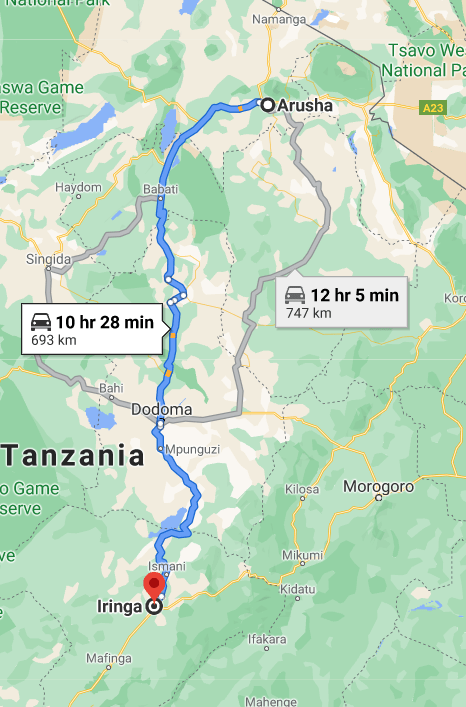
Having left the mountains behind and descended into a country of scrub and low-pouring trees, we arrived at Tondumo where the Nyasaland Trail and the Great North Road fork: the former going to the left almost due south and the latter turning sharply off to the west towards Abercorn, situated at the southern extremity of the mighty Lake Tanganyika. This lake is 400 miles long and, like Lake Nganza, was the scene of unbelievable naval warfare during the Great War. Naval warfare in the heart of Africa!  Tondumo was 72 miles from Mbeya. These 72 miles had taken us 2 hours 48 minutes (3 minutes more than schedule!).

We turned sharply to the right at the signpost “Great North Road”. My readers may remember that, in the description of our preparations, I wrote “I can hardly write those words without smiling.  You shall hear the reason when we arrived there.” We have arrived there and here is the reason, Readers, please disabuse your minds of any visions of A1, disgustingly narrow little country lane that it is in some parts, with its smooth tarred surface, its milestones, its towns and villages, its smiling well-kept air. The Great North Road of Northern Rhodesia is not like this or like any road I have seen in England. Picture to yourselves a pass grown track, about seven feet wide, deep in liquid mud, winding its way through a deserted forest of stunted trees and you have an idea of the Great North Road of Africa. It is more like an ill-kept ride in a great wood on some impoverished estate than anything else I can think of, and it makes difficult and unpleasant travelling.  At frequent intervals it crosses small streams by crazy rotten wooden bridges that always caused us apprehension for fear that they would give way beneath us. Each time we came to one of these we would slow down to 15 miles an hour and survey it anxiously before venturing to cross it. Several times we had to stop and lift out of the way broken branches that lay across the road. It became unutterably wearisome and tedious, this creeping along down the muddy narrow track through stunted tress and coarse rank grass, with no distant views of hill or sky to break the monotony of the vista of undergrowth and the dirty little ditch we were following. The Great North Road! For hours we crawled along, 30 miles an hour seemed a reckless speed, as the bushes brushed the sides of the car – no gleaming paint on them now to be spoiled! – and the car skidded and slid on the slimy surface. Hours of boredom when we grew too fed-up even to talk but counted off the minutes till we reached the Abercorn Fork, 116 miles from Tondumo. This is 11 miles before the road reaches Abercorn and it is at this point that the road from the south runs into the one, we were following which goes due west.  It is actually a fork if one is proceeding from Abercorn and not towards it, as we were, and at this fork, if coming from Abercorn, one turns right from Mpika and the south and left for Mbeya and the north. 

At last, when we had come to believe that we should never reach it and that this endless track would continue for ever, we came to the fork and a signpost. We stopped. We had been full of hopes of this road southwards from the Abercorn Fork, for did not one of the guides I had consulted say that there was a bus service from Abercorn to Kapiri Niposte, nearly 500 miles to the south? We looked anxiously back to our left down the southward trail and our hopes were fulfilled. A wide avenue disappeared in the distance among the trees, a road, a real road at last. True, the surface was only of red earth and it was wet and sticky after the recent rains but it had any rate the semblance of a road. It was ten minutes past one when we reached the Abercorn Fork and we stopped here to verify the contents of our tank. We still had 200 miles to go to our next refuelling stop at Mpika and if for any reason we had used a lot of petrol we should have to run the 11 miles into Abercorn to fill up. We did not want to do this as it would mean an extra 22 miles, and we were glad to find it was unnecessary. We had plenty of petrol to go straight on. However, having stopped, we thought we would celebrate the appearance of the real road by eating something from our stock in the car. While we were eating, a Ford truck came along from the direction of Abercorn. There were two young Englishmen in it, and they stopped for a word with us. We asked about the road south, as they were heading that way, and they told us it was not too good as there had been a lot of rain. Once again, we had to explain the battered appearance of our car, a story that now flowed almost automatically from our lips. They went on and a few minutes later we followed them, their tracks being quite distinct on the soft, muddy road. The 116 miles from Tondumo to Abercorn Fork had taken 4 hours 22 minutes and we had gained 8 minutes on schedule (another triumph!). We stopped there 13 minutes before we were once again on our way.

The road was quite good, and we were in high spirits as we sailed merrily along at 35 miles an hour. In about 10 miles we came to a fork where a narrow little track forked to the right and our good red road swerved slightly left. We followed it. But some sixth sense made us uneasy. We stopped. We looked at a map. There was no fork shown. We went on again but very slowly as we both had a feeling something was wrong. I called out, “Stop, Humphrey.  Look, there’s a white man. We’d better ask.” He didn’t seem to hear us call so I got out and walked across what appeared to be cultivated land towards him. I asked him if this was right for Kasama, and he replied, “Oh no, this is a private road to the Botanical Research Station. You must go back about a mile and turn sharp to your left.” I thanked him and went disconsolately back to the car. So, our beautiful, good road ended here, and we had to go along that dirty narrow little track that we had seen turning off to the right! I told Humphrey and we turned round. We went back and when we got to the fork, we swung round sharp to our left. Our worst fears were fulfilled. Here was the road “not too good” that our friends at the Abercorn Fork had told us about and we found ourselves again travelling along the same sort of dirty little track, hedged in by trees, that we had followed from Tondumo to Abercorn Fork. The only difference was that this red soil was most horribly slippery and we had to exercise the utmost caution.

We relapsed into gloomy silence, even Humphrey’s mercurial spirits not being proof against our disappointment and our joint hatred of this unpleasant road. On and on down this endless track we went, with nothing to look at and no scenery to enjoy. The Great North Road! We passed through Kasama and went on. In the last 82 miles we had gained another 15 minutes on our schedule, and this cheered us up for a little time, as it made up for the time we had wasted over our stop at the Abercorn Fork. We had come 272 miles from Mbeya since our start that morning and we had been exactly 7 minutes faster than our schedule. I was quite pleased with that!

But we were worried about another thing. 54 miles beyond Kasama there was a ferry over the Chambesi River and it was now just after 5 o’clock. Judging by our past rate of progress we could not hope to reach the ferry before 7 and it was a question whether it would be still running. If not, it meant a return to Kasama where there was reputed to be a hotel or a night in the car on the banks of the river. It was imperative, therefore, to get along as the road would allow.

I hesitate to describe the conditions we met with, for fear that my readers, with the recollection in their minds that this was the Great North Road, will refuse to credit the truth. We had reached low lying country draining towards the Chambezi River and here and there the land was swampy and marshy. Across these marshes the track was apparently built on some sort of a causeway: I say apparently because the surface was quite invisible. Briefly, one description will do for all these swamp crossings, though there were many of them, varying in length from 50 yards to a quarter of a mile or more. The grass grown track would descend a gentle slope to where the swamp lay, and suddenly the road would disappear altogether beneath long coarse grass. The only way to follow it without plunging into the swamp on either side was to keep one’s eyes firmly fixed on two dark lines which showed where passing vehicles had pressed down the grass, through it had sprung up again as soon as the pressure was relieved. Believe it or not, the grass through which the track ran rose a foot or more above the top of the radiator! The embarking on one of these crossings was a most alarming experience: it was like driving through an unchartered sea and one proceeded with one’s heart in one’s mouth, as it was impossible to see any sign of the ground at all. In front the grass rose five feet high in an unbroken sea, and only the two dark lines showed where the track lay buried deep beneath it. As we went forward, the radiator pressed down the tall grasses immediately in front and Humphrey, looking out through the rear window, said that they sprang up again immediately the car had passed over. We were in terror in case the track, deep down out of sight might have broken away. If it had done so we should have plunged headfirst into the swamp, and it had to be taken on trust that the track was sound. On each side one could see nothing except this long coarse grass growing out of the stagnant stinking mud. These crossings, and there were many of them, precluded any speed above about ten miles an hour and the first few filled us with apprehension. Later we became inured and merely amused. The Great North Road! Can my readers wonder that I can’t help smiling when I write those words?

Between the swamps the road was not too bad, and I pushed on desperately in the failing light in an attempt to reach the ferry before it became quite dark, while Humphrey, watching the speedometer, counted off the miles. Soon it became obvious that it would be dark long before we got there: indeed, it was inevitable for here night falls at this time of year at about 6.30. Crossing the swamps through the deep grass was queer enough by daylight but it was even more eerie in the dark, as the headlamps taken from an old Hillman at Nairobi and fitted by the Wolseley agents there, were well below the level of the top of the grass, so that the beams shone strangely upward through the thick coarse stems. We were still hopeful that perhaps we should not be too late to catch the ferrymen and when Humphrey told me that we were only two miles from the ferry I began to blow long blasts on our twin(p.372) horns, hoping to warn them that a car was coming. It turned out quite all right in the end and undoubtedly, they had heard our horns and seen our lights. We reached the banks of the Chambezi River at 8 minutes past seven, having taken just two minutes under two hours to cover the 54 miles, and a pretty strenuous two hours they had been. So that, once across the ferry – which took 25 minutes – I was glad to hand over the wheel to Humphrey and relax in the comfortable seat while he dealt with the difficulties of the route.

As we left the ferry it began to rain, and we ploughed along through the darkness over the sodden track for what seemed like hours. This was the first time we had met with really heavy, solid rain and we were anxious as to the car’s waterproofness. We were relieved of our greatest anxiety, doubts as to water tightness of our sunshine roof. The roof itself was twisted in an extraordinary manner, just as if one were to take a sheet of stiff paper by opposite corners and bend one corner up and one down. It was something of a tribute to the steel body, that in addition to having undoubtedly saved our lives by withstanding the shock of our tremendous fall, the roof remained absolutely watertight except for one tiny drip that fortunately fell just behind the driver’s seat. The sliding roof was, naturally, immovable but we were saved from the cascades that we had feared might pour in through the edges.

Round the frame of the windscreen, which, owing to the rhomboidal shape of the opening, could not of course be got back into place, we had instructed the Wolseley agents at Nairobi to pack thick sponge rubber and very little water got in through this. But there was one thing that caused us a great deal of annoyance until, the next day, Humphrey found an ingenious solution. As the windscreen frame was fixed outside the front line of the body and not lying snugly within it, we had given evidence that holes should be drilled in the frame and that this latter should be held to the body by small bolts and nuts.  We had given special instructions that these bolts should be left slack in order to avoid any strain on our plate glass windscreen. However, some garage hand, with an excess of vigour, had pulled the nuts up tight and cracked the glass from top to bottom. There had been no time to cut another glass so the cracked glass remained. The crack ran diagonally from top to bottom of the glass just to the left of the driver’s line of vision and what drove us nearly insane was the action of the windscreen wiper when it was in use. Every motorist knows that a windscreen wiper, moving in a steady arc across the driver’s line of sight, is quite invisible because of its continuous and rhythmic movement. But every time our wiper, on its right handed swing, came to the crack in the glass, it hesitated at the ridge formed where one broken edge stood up above the other: hesitated as if to gain momentum and then swung rapidly across. On its return journey it ran smoothly over the crack, as it passed easily down the little ridge which it had had to jump on its right-handed swing. The intermittent movement, the pause, the accelerated swing, then the steady return, and the pause again drove us nearly crazy. We found it almost impossible to see the road: one’s eyes automatically focussed themselves on the erratic course of the wiper blade. It was not until the following afternoon, after many hours of torture from the wretched little cause, that Humphrey found a simple solution. Cutting off short strips of surgical plaster out of our first aid kit, he stuck them across the crack in a left to right direction, that is, horizontally. When the wiper blade reached the strips, it ran smoothly up and over the crack, and the problem was solved. True, after an hour or so of really torrential rain, the strips were washed loose but we kept a supply ready and replaced them as necessity arose. I have gone into this small matter in some detail because it shows the kind of petty difficulties that may arise and, although an erratically moving windscreen wiper may not sound very serious, I doubt if we should have been able to endure the long hours of driving in torrential rain that we had to put up with unless a solution had been found. The strain on our eyes was terrible and it was difficult to watch the road, past this infernal wiper blade, as intently as it is necessary to watch it on the type of road we were to encounter.

It was very late, 10.48 to be exact, when we drove up to the Crested Crane Hotel at Mpika. This, in addition to being the Shell Depot at Mpika, has the reputation of being one of the best hotels in Northern Rhodesia. It bore out that reputation. Our host, Marriott by name, is a true example of the excellent type of African hotelkeeper. He is an enormous fellow of a most cheerful and comforting appearance. He was in bed when we arrived. He was leaving first thing in the morning by air for Ndola, in the Rhodesian copper fields, but he made no fuss about turning out to greet us. The hotel, built in a mixture of English and African style, was beautifully furnished and equipped with lovely bathrooms. Our host the proprietor, wearing a wonderful silk dressing gown over his pyjamas, joined us in a drink and called out his boys to prepare a sandwich meal for us. Meanwhile we took it in turns to superintend the refuelling of our tank which had to be done by the awkward method of filling cans from drums and emptying them into the filler cap of the tank through a funnel. It took nearly an hour to do this job and why the whole place was not blown sky high by the ignition of the petrol from the hurricane lamps the native boys used is simply one of life’s mysteries. We had long ago decided to stay the night here, as we had had a long and hard day and felt very tired when we sought our comfortable beds some time after midnight. We had covered 398 miles that day and felt that we had not done so badly. We were exactly 2 minutes quicker than the schedule time I had allotted for the distance.

Chapter 25 – Iringa – Mbeya 243 miles 16 January 1939

Next morning we pushed the car across to the garage, dug out the old voltage control from among our spare parts, had the battery put on to be given a quick charge – it was completely flat, as we expected – and returned to the hotel for breakfast.

After breakfast Humfrey went over to the garage, insisting that I should lie on a sofa and do nothing. My leg was very painful, and I still felt very ill. I was very upset because I felt that I was holding Humfrey back, though actually it was the voltage control going wrong that had stopped us the night before. I was conscious that, partly due to the poisoning from the mixture of drugs, and partly to the nerve shock, I was quite unfit, and I was sure that I ought really not to have gone on from Nairobi. I was acutely miserable. Humfrey came back at intervals to tell me how the work was going on and, most characteristically, told me not to be an ass when I hinted at my feelings. He said, “I’m only sorry you aren’t enjoying it.” Not a word about the worry of having a sick whining co-driver, only that he was sorry I wasn’t enjoying it.

At 12 o’clock he came over to say that the work was nearly finished, and he thought we ought to have a quick lunch before we started. The proprietor agreed to give us something at once – we found these British hotel proprietors a very kindly and obliging lot – and at 12.42 we left Iringa. It was a sad waste of nearly a day, but it could not be avoided. Once in the car and underway, I felt better as I usually did. Heavy rain had been falling all night and most of the morning, though it had stopped now. This rain made a precipitous, winding descent immediately outside Iringa doubly dangerous owing to the slippery state of the road. But once down this we found a good sandy road that would have been a fast one if it had not been for the deep sand that made anything like high speed out of the question. We bemoaned our fate that we had not struck this road when it was dry.

The country soon changed and we began to climb again. Up and up wound the road till we reached the summit of 6600 feet. I think that I have forgotten to mention that after we left Nairobi we had re-set the carburettors to compensate for the high altitude and this had made a tremendous difference. The engine was twice as lively as it had been before and had quite regained its old rigour while our petrol consumption which had remained steady at 14½ to 15 mpg. all the way across Africa, immediately improved to 18½, 19 and later to 19½. With our 31 gallon tank, this gave us a range of over 500 miles without re-fueling and we felt much happier, besides enjoying the increased power of the engine. We went on and on through pleasant, wooded country, though the road was so winding and steep that we felt we were getting along very slowly. Our progress was not assisted by meeting several native-driven lorries, these carry on a goods service as a feeder to the German-built railway line running through Dodoma, eastwards to the coast at Dar-Es-Salaam, and westwards to Mwanza on that great inland sea, Lake Victoria. The drivers of these lorries were as utterly reckless as native drivers always appear to be and instilled such terror into us by their method of travelling as fast as they could go round every bend, blind or not, quite regardless of the possible approach of any other traveller from the opposite direction that we became reduced to a pitiful crawl round each corner with frequent blasts on our twin horns to give advice of our presence. Nevertheless, we had averaged over 30 miles an hour when we passed a delightful looking little hotel standing in beautiful wooded country on the banks of the pretty Tchimala River. The hotel was called the Tchimala River Hotel and we wished we could spare the time to stop. If it was half as delightful as its lovely surroundings made it appear, it was a shame that we could not stop there. But time pressed and we were anxious to get as far as possible over the mountains which separated us from Mbeya before darkness fell. We had no idea then of the terrors of that mountain passage and were enjoying the wooded glens and the beautiful hill views as we began to climb steadily into the gathering darkness. As we emerged from the forest line into the bare rock country, darkness began to fall and the road, wet from the heavy rains, began to get exceedingly slippery.

Driving very cautiously on a steep down grade, I rounded a shoulder where the narrow road swerved sharply to the left, with a precipitous and unguarded drop in front, when to my horror I saw about 100 yards ahead, stationary in the middle of the narrow road, a lorry with several men around it. I said to Humfrey “I can’t stop,” to which he replied in a calm conversational tone “You’ll have to.”

I changed down hurriedly but gently – for fear of starting the rear wheels sliding – into third and then into second and with a mere caress of the brakes, for I didn’t like the look of the slimy road and the hideous open precipice on my right, I managed to pull the car up about 10 feet short of the obstacle which was completely blocking the road. “Well done, Bertie,” said Humfrey as we got out to survey the prospect of getting by. The owner of the lorry, a German farmer, said” Ze road is very dangerous. I put on ze chains.” He had calmly stopped in the middle of this narrow road to put chains on his rear wheels!”

We had no intention of putting on chains – we trusted to our good Dunlop tyres. All we thought of was getting past. With Humfrey guiding me from in front, I managed to squeeze by with an inch to spare between the lorry and our Wolseley and not much more on the precipice side. We had no idea that the road was truly as dangerous as the German had said it was, but we were soon to know! Immediately beyond the lorry, the road shelved sharply down to a wide hairpin corner followed by a step ascent. Starting slowly in second, I braked gently to steady the car and immediately the tail slid round. This having been corrected, the car swung the other way, and so in a succession of broadside skids we reached the corner. It felt to me as though the car was travelling at 100 mile an hour and was quite out of control. Actually, I suppose our speed was about 15 or 20 mph and the car was obviously not completely out of control because I managed to slide her in a huge broadside skid, round the corner. Immediately I opened the throttle to pull her straight for a run at the steep climb ahead, she skidded across the road and I had to ease the accelerator. How we got to the top, I don’t know, but it took all the skill I had acquired in years of competition driving at home to get the car up that slope and to control the violent skids that anything more than a mere whiff of throttle produced. At the top I thankfully handed over to Humfrey for we had always agreed that if there was anything particularly difficult to be done, he as the skipper, was the one to do it. Anyway, if this agreement had not been made long before we started, I have no doubt that, as my confidence had been somewhat shaken by the crash at the bridge.

I implored Humfrey to go slowly and he replied, “my dear old chap, I have no intention of doing anything else,” and we crept slowly off along that perilous road. Humfrey handled the car like an angel as we climbed higher into the mountainous, rarely attempting more than about 10 miles an hour and frequently doing much less, while I sat beside him with nerves quivering.

At last, we came to one long ascent that still lives in my memory forever. It was not very steep, probably about 1 in 8, it was quite straight, and the surface was covered with slimy glutinous mud. On Humfrey’s side there was a sort of rocky hillside rising gently while on my side there was a smooth stretch of muddy earth sloping steeply downwards to a precipice edge and through the gloom, I could see the top of lofty trees 1000 feet or more below. Slowly we started to climb and almost at once Humfrey had to get into bottom gear. Then ensued a struggle between a magnificent driver and the vile road that was trying to send us hurtling down over that precipice to certain death. We ascended the hill at about 4 miles an hour, with the car first broadside on in one direction and then the other. The least hard touch on the accelerator pedal would have sent us sliding over the smooth mud and down into the treetops: the slightest insufficiency of throttle opening would have brought us to a stop and would have sent us slipping backwards with locked wheels and out of control, for the brakes could not have held the car on that surface.

It was a wonderful piece of driving and I sat, literally sweating with fear, as we gradually neared the summit. Backwards and forwards swung the tail of the car as we gained a yard at a time and each time Humfrey brought it back, panting with the intense mental strain but at last the summit was gained and he bought the car to rest.

“Bertie,” he said, “we must put on chains. It’s far too dangerous to try and get down the other side without the.” I agreed and got out of the car to find, to my utter astonishment, that I could not stand without holding on to the car for support. Humfrey, though decidedly shaken, was not so utterly unnerved as I was but we both felt the need of a good stiff drink of whisky.

Owing to Humfrey’s broken hand, he could not be of much assistance in fitting the chains, and I viewed with a feeling of considerable helplessness the task of fitting the chains to these 9 inch tyres single-handed, particularly as, even after the whisky, I was still so shaky that I was hardly able to stand. Just as we had spread one of the chains out on the ground and I was about to commence fitting it to the wheel, lights appeared over the crest of the hill and a lorry pulled up facing us. Humfrey went over to it, hoping to get some information from the driver as to the state of the descent and returned in a minute or two with a more cheerful expression. “Look here, Bertie,” he said “I can’t make the native driver understand what I mean, but I’ve had a look at his back wheels. He hasn’t got chains on and his back tyres are absolutely smooth. If he can get up like that, surely, we can get down without chains. What do you say?”

I said I was quite agreeable to try if he liked. I think at that moment, I would have been prepared to face anything rather than the prospect of attempting to fit those colossal chains single handed in the darkness. And of course, as usual, there was sound common sense in what Humfrey said. We replaced the chains in the car and took our seats. Edging past the lorry we started on the descent, noting at the same time, that the driver of the lorry and his mate were getting busy putting chains on their rear wheels. This convinced us that the driver, presumably a local, knew of the dangers ahead and confirmed us in our opinion that we should find the descent less bad than the climb we had accomplished.

Once again, I begged Humfrey to go slowly and he repeated his previous remark, that he had no intention of driving anything else. Slowly we crept down the steep winding road, using second gear all the time to obviate, as far as possible, the necessity for using the brakes. It was now pitch dark and we crawled slowly down, rounding corner after corner, but meeting with no serious difficulty. I was frankly terrified, but Humfrey, as usual, considerate of my unnerved condition continued to creep slowly along. He did not dare to take his eyes from the road, but from time to time he would ask me if I could see anything out of my side window. At first, I could see nothing but a dark cloudy sky, but as we descended, I told him I thought I could see, far below, hills and even trees. There was evidently still a considerable drop on my side. I asked him what the surface felt like and he replied “Quite all right.” We agreed that what would probably happen would be that we should continue to go crawling along over bone dry hard roads on level ground long after we had left the mud and the mountains far behind. Nevertheless, we decided to continue our invariable policy of “Safety first.” Eventually, it was clear from the view out of my window that we were definitely out of the mountains and back in the region of trees and vegetation and in a few miles, we turned off the southward road into the township of Mbeya, lying a mile or so off the direct road. We stopped at the hotel and I got out, still feeling my knees wobble. Humfrey, directed by the hotel proprietor, went off to find the Shell agent and re-fuel while I, after a wash, sat down in the comfortable dining-room to wait for him. I felt very ill and shaky. Soon he returned and showed me the telegram that had been awaiting us from the Shell representative at Salisbury. It read “Nyasaland Trail impassable. Great North Road probably passable with care.” This sounded ominous but it was clear that in face of this advice we should be foolish to attempt the shorter route through Nyasaland and Portuguese East Africa and we must make up our minds to the detour via Broken Hill and Victoria Falls.

When dinner was brought, I took one spoonful of soup and then my stomach revolted. Please don’t think that the soup was bad: it smelt and tasted most appetizing, but I was quite convinced that if I attempted to touch it, I should be sick. So, I sat smoking and sipping a whisky and soda while Humfrey ate a hearty meal and we discussed our plans for the night run. I was miserably conscious that I felt utterly unfit for it, but I was quite determined not to admit it.

After Humfrey had finished his dinner, he left the room rather hurriedly and returned in a few minutes with a serious face. He sat down. “Look here, Bertie,” he said, “I don’t think either of us are up to going on tonight and I booked rooms here. I felt perfectly all right and I feel perfectly all right now, but I have just been sick. I think we should be very unwise to go on. What do you say?”

I admitted then that I was not looking forward to a night journey and shortly afterwards we retired to bed. It was horribly disappointing. Each morning we would start off feeling refreshed and well after a good sleep, but, towards evening, we would both begin to feel that a night drive was undesirable, to say the least of it. I was in a much worse state than Humfrey, but I know that he was feeling the strain; the long, drawn-out strain of continuous travelling coupled with the after-effects of our crash was telling on our reserves of nervous energy more than we had appreciated. We deplored the waste of time, but, under the circumstances, time was not really of such vital importance, as we could not now, after having lost so much time – ten days to be exact – hope to put up the sensationally fast time from England to Cape Town that we had hoped for when we started. The important thing now was to get the car there and the only way to do this was to husband the reserves of energy still left to us.

Chapter 24 – Through Kenya and Tanganyika. 14th January 1939

After all, it was 3 o’clock before we left Nairobi. The Wolseley agents had been having a lot of trouble with the voltage control, for when they fitted the spare one, the dynamo would not show charge. But eventually they satisfied themselves that all was well, and the car arrived at the door. The new knobbly tyres looked magnificent, and it was with the utmost pleasure that, after photographs had been taken, we took our seats in our good old warrior and followed Graham Bell, who was piloting us in his Bentley, out of town. It was lovely to have a windscreen again and everything seemed perfect, as having said goodbye to Bell with sincere thanks for all he had done for us at Nairobi, we set out on the unknown part of our journey. We now had about 3600 miles to go, and we were full of hope that we might, after all, put up a decent time from England to Cape Town. We had, so far, taken 23 days and we hoped to reach Cape Town in six days more, driving day and night: but we had received ominous warnings of bad weather, and worse roads, ahead. We had got Finn to wire to the Shell representative in Salisbury as to the possibility of using the Nyasaland Trail, but the reply had been utterly discouraging. The Shell people at Salisbury, however, had promised to wire us the latest road information to Mbeya – place just before the fork of the Nyasaland Trail and the Great North Road. We were anxious to use the former if possible as it was much shorter and saved the huge detour to the west via Broken Hill and the Victoria Falls. However, we didn’t bother about that as we drove steadily south from Nairobi. It was 850 miles to Mbeya, and we put all thoughts of the far distant future out of our heads.

Soon after leaving Nairobi, we entered the immense game preserve lying south of the town. It is wide open rolling country and driving through it is exactly like driving through an immense zoo.  We were thrilled to see here, feeding close to the road, huge herds of zebra, lovely fat tubby creatures with their beautiful striped skins and intelligent heads. It is a pity they are too intelligent to allow themselves to be trained as beasts of burden, unlike that stupidest of animals, the horse. They swarm in thousands in Africa but are utterly useless. They would not allow us to get near enough to get really good photographs of them, and we wasted a lot of time before we concluded that they were timid – or too wise! – to allow man to approach them. There were also quantities of antelope of various sorts, running with the zebra: one tiny species not much bigger than a large terrier, was so pretty that we wished we had someone with us who could tell us its name and that of the other varieties to be seen in the preserve. In addition to the zebras and the antelopes there were enormous herds of buffalo; I do not wish to exaggerate but there must have been thousands of them. They were not at all timid like the zebras but would stand close to the road and watch the car as it went by. We felt ourselves extremely ignorant of the habits of all this wildlife, but we presumed that the buffalos were viewing us with interest and not with malice! We were not quite certain about this however, so if any herd or part of a herd showed a disposition to cross the road we waited politely until its passage was complete before attempting to proceed. We did not consider that this showed cowardice on our part, but only courtesy – or perhaps prudence. We were disappointed not to see any lions, as we had been told at Nairobi that they are frequently to be met with in this game preserve. I believe that they are an awful nuisance to cars as they are fond of lying in the road and will not bother to move. There is, of course, nothing whatever to be feared from this most cowardly “King of Beasts”. Rhinos are frequently to be seen here and they are the most dangerous of all the wild animals in Africa, as they are apt to charge anything in blind rage. We were informed that a rhino has been known to charge a train! and cases of their attacking cars are not uncommon.

After about 30 miles of this wonderful passage through the game preserve the road enters a region of lush country with coarse grass, studded with small trees, and here we were delighted to see a pair of giraffes feeding on the trees. Seen like this in their natural surroundings, they are frankly incredible. We looked at them with astonishment hardly believing that they could be real. They were rather shy of the car and when we stopped to take a photograph they moved slowly away with their singularly ungainly action. They were enormous beasts and their silly little heads, on which a number of small birds were perched, at the top of the long necks, gives them a most idiotic appearance. They are most unfinished looking. Later, another pair with a baby giraffe moved slowly across the road in front of us and the baby did not look quite so stupid as its parents as it had not yet developed the enormously long neck and so did not look so out of proportion.

Watching these animals and eagerly looking out for others, we ceased to bother about time and drove steadily on over the not too bad road through the pleasantly warm afternoon. Personally, I felt wretchedly ill, but was better able to forget my troubles when it was my turn to drive. Humfrey’s left hand had been bandaged in plaster of paris and this made it awkward for him when he had to change gears, but he felt very little pain from it at other times.

Far away in the distance, there hung a white cloud, and we discussed the oddness of its appearance there: for there were no other clouds to be seen in the clear blue sky. Humfrey was studying the map and suddenly said, “I don’t believe that’s a cloud at all. I believe its Kilimanjaro. According to the map, it ought to be just about in that direction, but it’s a hell of a long way off.”

I asked how far, and when I was told that it was 120 miles away, I expressed disbelief as to the possibility of seeing it at that distance. We wrangled over this for some time, but eventually as the cloud persisted in staying exactly in the same place, I was compelled to agree that perhaps I was wrong and that it was Kilimanjaro after all. Anyway, for several hours it remained hanging white in the blue sky and as we drew nearer, we could plainly see the white capped snow crest towering up into the clear blue sky. I was then prepared to admit that it was Kilimanjaro, that huge mountain, perpetually snow clad, though within 300 miles of the Equator. Our route passed far to the west of the great peak and when we appeared to be abreast of it Humfrey stopped the car to try and get a photograph. It was about 60 miles away and the photographs did not show the white crest as clearly as we could see it with the naked eye. When Humfrey got out of the car and was stooping down to get the Wolseley into the foreground and Kilimanjaro’s peak behind it, he said “Bertie, you might keep a look-out. This sort of bush country looks to me like lion country and I don’t want a lion creeping up and biting me in the behind when I’m not looking.” No lion appeared, however, and the picture was duly taken.

For some time, having been suspicious during the first moments of our exit from Nairobi I had been watching the ammeter and at last I said, “Humfrey, I’m sure the dynamo isn’t charging. It’s been showing a small discharge ever since we started, and it ought to have shown a big charge directly after we’d used the starter at Nairobi and to be showing a small charge all the time.”

Humfrey replied that he was sure it was quite all right and that as the battery had been recharged at Nairobi it was probably well up so that the starting of the engine had taken so little out of it that a high rate of charge had not been necessary. I was not quite convinced but somehow or other, probably because I didn’t feel up to another argument, the subject was not pursued.

Soon after we had stopped for the Kilimanjaro photograph, it grew dark, and we drove steadily on through dull and uninteresting bush country. Eventually we arrived at a T road where the signpost arm pointing to the left said “Arusha” and to the right “Dodoma”. We turned the car to the left down the straight road to Arusha 3 miles away and stopped at the very comfortable Arusha Hotel. The host kindly went off with Humfrey to find the Shell representative at his house and get the car filled up, while I went inside. When Humfrey retuned and had had a wash, dinner was ready. I felt I couldn’t look at food, yet after a large whisky, but I was unable to resist a dish of strawberries. Strawberries in January were something I had not met before, and I managed to eat some of them.

We were in bed by eleven and were called at 5am. After drinking some coffee – I was still unable to eat anything – we started from the very hospitable and comfortable Arusha Hotel at 5.42 while it was still dark. The next stretch of 105 miles to Babali was one that we had rather dreaded. Before we left England, we had received grim accounts of its possibilities. The surface is comprised of ‘black cotton soil’: this is black fertile stuff, excellent for growing crops but unpleasant to drive over. After rain it becomes simply impassable, and if any readers want to realize what it is like they should take cars out to the nearest newly ploughed field after a week’s rain and endeavour to drive straight across it! We were afraid that we might have a lot of trouble if the road was wet and as we were now in the season between the ‘short rains’ and the ‘long rains’ – a period of a month or so – there was every possibility that it might be wet. However, we had faith in our Wolseley, in our great knobbed tyres, and in our ability to deal with anything we might meet with.

We met with nothing to give us any trouble. The road had been wet, and we found foot deep ruts cut by passing vehicles and occasional ‘grave-yards’ – oh shadows of the Sahara! – where they had stuck and had to dig themselves out. But ruts that the Germans must have put into the making of this road. For this was Tanganyika, lately German East Africa, and now British mandated territory. It was over this country that British forces from British East Africa – now Kenya Colony – and South Africa had chased and fought the Germans through that difficult campaign. Appalling country for fighting. At last, we reached the summit at 5500 feet and as we went on, we remarked on the curious fact that though we seemed to be always climbing these mountains, we never appeared to go down on the other side! Unfortunately, our aneroid barometer was out of action, not having appreciated its bath in the river and we were further annoyed to find that our compass now had an error of approximately 90 degrees. It had been functioning quite correctly since our crash and we concluded that some curious person either at Nairobi or elsewhere, had unscrewed the little cup below the case which holds the magnets to correct it for any masses of metal (such as the engine) that maybe in the vicinity. Anyway, we could never, after leaving Nairobi, rely on it again and we were to miss its help greatly at later stages of our journey. After reaching the summit at Pienaar’s Heights the country opened out and we saw a great deal of native cultivation being carried on in very fertile-looking ground. This cultivation is now being regulated under wise government control in order to correct the reckless native habit of growing crops for two or three years without giving the soil either rest, manure, or deep digging, and moving onto another piece when it is exhausted. It is this lazy practice that is largely to account for the so-called desecration of the land and the rapid encroaching of desert over large parts of Africa. The natives only scratch the surface of the soil: then, having exhausted it, leave it to be parched by the burning sun and finally blown away by the winds that spread it far and wide in the form of sand.

But the native cultivation in this part of Tanganyika seemed to be better organized and we saw natives industriously watering and digging deep trenches to reach the unburnt earth below. Their crops, mostly for immediate home consumption, looked in excellent condition and the men themselves are a fine hardy-looking lot.

Later the road climbed again round the shoulder of a rugged hillside, and the road was wide as it descended again, and a broad vista of country opened before us. It was bleak and bare and parched under the rays of a blazing sun. The heat was terrific as we sped over a good road towards Dodoma, and we gratefully sucked oranges as food and drink. Invaluable things we found them, these oranges, but we were annoyed that the oranges that Humfrey had bought at Leatherhead, and which were marked “Produce of South Africa” had been spoiled by their twelve hours of immersion in the river. We had childishly set our hearts on returning at least some of them to their native home!

It was 1.52pm on Sunday the 15th January when we drove into Dodoma. We had been worried about our re-fueling stop here, because it was a Sunday afternoon, Finn, the Shell representative at Nairobi had wired Dodoma before we left, that we expected to arrive at 5pm and to inform the Shell agents, an Indian firm, that they were to be ready to re-fuel us at that hour. We had covered 272 miles from Arusha, having taken exactly 8 hours instead of our schedule time of 10½ . We had averaged 35mph from Babati and we were nearly 3 hours early; we were afraid the Shell agents would not be ready for us and that we might have difficulty in finding them. We need not have worried. Shell organization is not thrown out by such a small detail as arriving 3 hours early! As we drove into the town past the aerodrome, a figure stood in the middle of the road, waving its arms. It was that of a gigantic native, dressed in blue shorts, and a blue jersey with a huge golden Shell emblazoned on the breast. Was Dodoma ready for us? He sprang on to the running board as I slowed down and waved me forward. He kept on urging me to greater speed till I was afraid he would be blown off the running-board! At last, we saw a Shell pump by the wall- side and the native waved me in towards it. We stopped. These Indian traders were princes. Everything was prepared for us and both partners were there (on a Sunday afternoon!) to ensure that arrangements were satisfactory. We re-fueled and put some oil in the engine while we drank cold beer that was waiting for us. Humfrey scribbled a cable to Thomas reporting our progress and a wire to Finn thanking him for the excellent arrangements: these the agents promised to dispatch early the following morning. And we were off. We had stopped at Dodoma for 16 minutes! Leaving Dodoma, the road remained good as we descended imperceptibly from nearly 4000 feet to 2200, where we knew that we had to cross the Ruaha River. This river is liable to flood in the rains, but when we reached it and crossed the majestic iron bridge, it was in its most innocuous mood. The floods sometimes extend for 10 miles on each side and there were traces of this in the markedly fertile appearance of the soil in the neighbourhood of the river.

Ten miles further on the road began to climb again through similar sort of country to that we had met with before, the steep narrow road winding up through a forest belt till we left the tree tops, far below.

Up and up the road twisted and turned, on our right a dizzy drop to the forest depths below. In 10 miles we climbed from the river level at 2200 feet to the 4000-foot line and 30 miles further on we were at 5400 feet. Just as darkness fell, we were disgusted to find rain – a steady downpour. Humfrey switched on the headlamps and immediately the engine cut out completely. Off went the switch and the engine took up again its steady rhythm. Several times he tried but each time with the same result. We cursed heavily as, after a discussion, we decided that there must be an exposed wire somewhere in the lamp circuit and that the rain had found its way in so causing a short. We certainly had no intention of starting to fiddle about with the wiring in the pouring rain. We were only 3 miles from Iringa so we decided to go on without lights and see if we could get a garage there to find the trouble while we had dinner. We were intending to drive on through the night; though I personally felt so wretchedly ill that I would gladly have welcomed almost anything which would have compelled us to stop, though I did not say so. As it was difficult in the growing darkness to see through the rain without lights Humfrey switched on the windscreen wipers. Immediately the engine misfired horribly but did not stop. Stopping the wiper brought back the engine’s normal smooth rhythm and we came to the conclusion that there must be a general short-circuit somewhere. We thought that perhaps rain had blown in through the now ill-fitting bonnet which, as I have said, was only held in position by one broad strap, all the proper fastenings having been torn out in the crash.

So, with no lights and no windscreen wiper Humfrey drove sedately through the already pitch darkness into the pleasant little town of Iringa and stopped outside the hotel. It was 12 minutes past 7. We had gained more than an hour on our schedule from Dodoma and had covered the 161miles in 5 hours, averaging 32 miles an hour.

Humfrey got out and went into the hotel where he interviewed the proprietor on the subject of dinner. This being satisfactorily arranged he asked if we could get the car under shelter as we wanted to examine the wiring before going on, for it was obvious we could not drive through the night without lights. He pointed out a shed and Humfrey told me to drive the car into it. When I pressed the starter button, nothing at all happened and we thought that the starter circuit must be also concerned in the trouble caused by the rain. We got several of the native servants to give the car a push. The engine started up at once and I drove the car into the shed. Humfrey said “Switch on the headlamps, Bertie; they’ll help us to see.’ I did so. A dim red glow appeared from the bulbs. The mystery was solved. The fact that the rain had started exactly at the same moment as darkness fell had misled us into thinking that water was the cause of the engine cutting out when the lamps were switched on. Of course, it was not so. If it had not been for the rain, we should have known at once where the trouble lay, and the dynamo had not been charging – our battery was flat. There was just enough current left in the battery to supply the coil for the ignition but not enough for lamps as well. Water had nothing to do with it and I had been right about my misgivings as to the ammeter reading when we left Nairobi. The spare voltage control fitted there was plainly faulty, and the dynamo had not been charging the whole time, so our long-suffering battery had now run down completely. Humfrey said at once, “That settles it, Bertie, we shall have to stay the night. We can’t do anything now but, in the morning, we must get the old voltage control put back. We know that that will let the dynamo charge even if it does charge at a fantastic rate.” I said, “Yes, I expect the battery will stand the over-charge. Anyway, it stood it from Juba to Nairobi.” Frankly, I was mightily relieved at the prospect of stopping for I had looked forward to the night’s run with much apprehension. I was not feeling well.

The hotel proprietors sent a message over to the garage, conveniently situated just opposite, where, he assured us, there was a first-class French mechanic, to warn them that there would be work for them first thing in the morning. We went into the very comfortable Iringa Hotel and after a drink or two I managed to eat something and went to bed, feeling literally like death.

We had really done quite well that day. We had covered 433 miles from Arusha and had taken only 13½  hours to do it, overall, in average speed being just over 33 miles an hour. We were particularly interested in Iringa, because when, in conversation with Thomas Wolseley’s General Manager, we had mentioned the name as one of our re-fueling points, he had laughed and said, “Iringa, eh? That’s the place where I ate the German Officer’s dinner.” Pressed for the story, he told us that while he was serving in German East during the war, he had got into Iringa just as the Germans left. At the hotel he had found on the table a meal, still hot, that had been prepared for a German officer who had left in a hurry as our troops came in. Thomas, being hungry, had wasted no time but had sat down and eaten the meal so thoughtfully left behind!

This is the route today from Google maps. It would take you 10 and a half hours. Bertie and Humfrey did it in 13 and a half hours. By my understanding that isn’t bad going.

Chapter 23 Kenya and Tanganyika. Nairobi – Arusha 183 miles 14 January 1939

Depositing our luggage at the hotel, we went straight on to the Wolseley agents where we arranged with the manager for them to start work on the car right away. We wanted the edges of the plate, made by Hetchen to hold the torn off spring hanger, spot-welded to the chassis. Although the bolts had held it perfectly, we thought it would be safer to have it welded in addition. We wanted glass cut to fit the rather odd shape of our windscreen frame. We were told that safety glass could not be cut to a special shape so that we should have to be content with ordinary plate glass. We wanted glass cut to fit the windows broken in the crash and a pair of headlamps to replace our lost ones. Also, we told the manager about the trouble with the voltage control. He said he would extract the spare one from our stock and fit that as the one we were using was obviously faulty.

This was really all that was required, except for routine greasing and verifying gear box and back axle oil leaks. “Mr Dunlop”, this was the precise title we gave to the various Dunlop representatives whom we met en route as we found it impossible to memorize all their names. Mr Dunlop had arrived in the meantime and we arranged with him to have our tyres changed for the Trackgrip type sent out from England for us. These are the type used by British Army vehicles: they have huge bars across the treads and are specially made for cross-country work. They were of 9-inch section, the same size as we had been using up to date. Having left our Wolseley for attention, Graham Bell drove us to the hospital where the doctor was waiting for us, Bell having phoned him in advance. He looked at Humfrey’s left hand and immediately pronounced the little finger to be broken and not merely strained as we had thought. He arranged to have it to be X-rayed the next morning and also wanted an X-ray photograph of the wounds on my left leg, which were still very painful.

Leaving the hospital, we called on our old friend, Finn, of the Shell Company, being received by him in his usual cordial manner. He is a great chap and is completely typical of the fine type of man selected by the Shell Company as their overseas representatives. We took him along with us to the hotel as he wanted to hear about what had happened to us and why we were so late in arriving. We had expected to reach Nairobi on the 3rd of January, whereas it was the 12th when we got there, so we were already nine days down on our schedule. At the hotel a reporter from the East African Standard was waiting as he duly had heard we had arrived (in the magic way newspaper people everywhere seem to know everything that happens) and he had been sent to interview Symons. This he did while Humfrey also undertook to write an article describing our experiences for the next day’s issue. Cables and telegrams then had to be sent off to Thomas, to the Sunday Times, to Stanton at Juba and to Humfrey’s South African papers. At last we managed to get to our rooms for a bath and a change, but it was very late before we sat down to dinner, Finn and Graham Bell keeping us company. After dinner we went off with Bell to find his pal Rolson whom we had met on the Rolls Royce trip and who was detained at his coffee mill as this was their busy season.

It was very late when we got to bed, certainly well after midnight, but we were not at all tired. We were in very good spirits; we were delighted with the car and how it had behaved on our 800 miles trial run and full of hope that we should reach Cape Town without further trouble. Our 800-mile run from Juba had actually taken us exactly 30 hours, including all stops and the little difficulties we had had in finding the way. When we complained to Bell about his road from Mile 66 to Molo, and explained what it was like, he told us that we had taken the wrong road and that we should have gone on another 200 yards before we turned off the road to Eldama Ravine. We should then have had the same magnificent road all the way that we struck from the last 10 miles into Molo. We then forgave him.

Next morning, we were up really early. Got X-rayed and later saw the doctor. Humfrey’s finger had been broken but had now mended, though it had set itself though not quite straight and it was a quarter of an inch shorter than the same finger on his right hand. He was very distressed about this and was not all comforted when I told him no one would ever notice. He was also worried because he could not stretch it out straight, but only in a sort of eccentric movement towards the other fingers. When I asked him why he wanted to stretch it out straight he seemed to have no answer ready but only said it would be a nuisance not being able to!

The doctor was not pleased with my leg – neither was I, as a matter of fact – and ordered me to take M&B 693, a new drug which is a powerful anti-toxin, in order to counteract the poison that had undoubtedly got into it. He also told me – a thing I never heard before – that the best dressing was cod-liver oil! I am bound to confess that this acted admirably. I used it daily for several weeks and it certainly helped the deep wounds to heal. The only disadvantages were the fact that I went about smelling like a fried fish shop and that any cat in the neighbourhood winced and marked predilection for my company!

Once again, as at Juba, the doctor asked me how I felt and when I said I never felt better in my life, strictly the truth, he shook his head and said he couldn’t understand it! I could not stand about much, because of my leg, so I stopped in the hotel while Humfrey went along to the Wolseley agents to see how work was progressing, as we were hoping to start for Cape Town that night. When he returned, he told me that we should not be able to start before the following morning as several things remained to be done and anyway another night’s rest would do us good. One very annoying thing had happened. The expert with the acetylene flame, while spot welding the plate onto the chassis, had directed his flame straight on a big bunch of wires coming from the main switchbox. I think there were 27 of them – and the insulation had promptly resented this treatment by instantaneously vanishing in a cloud of fumes, causing a complete short circuit. I believe that it took the electrical expert 6 hours to trace all the wires and to replace them! They were also having trouble with the voltage control.

Later Humfrey sat down with a typist friend of Graham Bell’s and dictated articles for his various papers while Mrs Robson, a charming young lady whom our friend Robson had met and married when he was in England two years before, kindly ran me out to show me a Kenya residence. When we got back to the hotel, there were two pleasant surprises waiting for me. Graham Bell, delighted that we were staying another night, insisted on giving a party for us at a restaurant and a cable had come from Thomas. His first words of this cable ran: “Tell Bertie all forgiven.” This was obviously in answer to the rather desperate letter I had written to him from Nianpara the day after our crash and – well, I was more than happy to get this very sporting message. The sending of it was completely Thomas-like. I prefer to say no more than that. He also said “Films arrived” but maddeningly did not say whether they had come out well or not. We had been very anxious about these pictures as they were documentary evidence of great importance as showing the amazing escape we had had and the frightful accident the car had survived. The sense of Thomas’ cable was that he was more than pleased at our being able to continue, but it was not until our escape and the photographs had been eagerly accepted as news by the daily paper in England. Such is the craving for sensation of some newspaper readers that when Thomas, who in addition to being a brilliant General Manager is also an accomplished journalist, rang up the news department, who are always on the lookout for ‘good stories’, then leapt at the tale of our escape with avidity. I cannot refrain from adding that the reaction of at least one editorial department (the newspaper concerned shall be nameless) was as follows: “Anyone killed? No? anyone injured? Not seriously, eh? Well, are they married? Can we have photographs of their wives?”  Such is modern journalism at its worst!

Graham Bell’s party that night was a huge success and our young host – he reminds me of nothing so much as a perky little Scotch terrier! – at the head of the table beamed through his spectacles as laughter reigned supreme. Suddenly half way through dinner, an awful feeling of illness came over me. I can’t describe it. I didn’t feel sick or faint but just awfully ill and when we came out Humfrey, who has some sort of sixth sense in these matters, said, “What’s up Bertie?” “I feel ghastly,” I answered, “I can’t think what’s the matter. I felt ill the night before. I must have eaten something that’s disagreed with me.”

Back at the hotel, I was given brandy and put to bed. Next morning Humfrey came to my room early and anxiously asked me how I felt. I replied that I felt awful. Humfrey told me that he had just rung up the Wolseley agents and they had told him the car would not be ready til midday, so I had better stay in bed. I know now that he also rang up Graham Bell and asked him to stand by to go on to Cape Town that day in case, I was not well enough to travel. We had arranged with Bell before we left England that he would be ready to go on with the survivor in case one of us, on arriving at Nairobi, was so exhausted by the journey that he was unable to continue. This he had agreed to do. We had considered this arrangement prudent in case of the possible breakdown of one of us under the strain of a long hard journey of this kind and in view of the importance of the issue if we had made a really fast run as far as Nairobi. I am quite sure that when this was arranged the same thought was in both of our minds though it was never voiced between us. I was quite determined that whatever might happen to Humfrey, I should certainly last the course; and I am certain that he had exactly the same feeling about himself!

He did not on this morning of the 14th of January tell me that he had rung up Graham Bell to warn him to be ready because he did not want to disturb my mind and I am sure he knew what my immediate reaction would have been. He was, as ever, the wise skipper who wanted his crew to get all the rest possible, so I took his advice and stayed in bed.

He came in again in an hour or so in neat perturbation. “Bertie,” he said, “I’ve just been round to see the doctor again about my hand and I told him you were feeling rotten. He said it was extraordinary as you said you felt so well. I suggested that it might have been something you had eaten or something he had given you. He replied that was not possible, because MB 693 agrees quite well with quinine,” (the common prophylactic against malaria), “when I said you were not taking quinine but atabrine he was horrified. Apparently, this MB 693 is very tricky stuff and combined with atabrine (and a good many other things), it is a rank poison. He said you must stop it at once and go on to quinine. So that accounts for you feeling so rotten.”

I believe I said, “Thank Heavens! I thought I was going to be ill.” Anyway, now that I knew what was the matter, I was at any rate certain I wasn’t going to die and when Humfrey said “So you think you’ll be able to go on?” I replied with vigour that of course I could go on and that I was getting up now.

Chapter 22 – Juba – Nairobi 742 miles 11 – 12 January 1939

It was fifteen minutes after midnight when we reached Mbale. I stopped at a cross roads in the middle of the town, or village. There was a large obelisk there which I have since discovered is a war memorial, but I didn’t stop to look at the obelisk. I stopped to see if there was a signpost showing the way to Tororo. There was not. Humfrey sat up. “Grrrh” he said. “By Jove, I’m cold.” I said that I was frozen. Shorts and a shirt had been too ample a costume for the extreme heat we had met with during the day, but in the middle of the night, nearly 4000 feet up, and with no windscreen except a piece of wire gauze they were not nearly enough, even though I had on a jacket before leaving Soroti. But the immediate business was to find the way and we had simply no ideas. The obvious thing seemed to be to go straight on over the cross-roads. We did so and in 200 yards arrived at another cross-roads. Over this too we went slowly, to arrive at a dead end with native huts facing us. We turned back, and frankly we had no idea what to do. We went back to the big cross roads with the obelisk and as a venture took the right hand turning. We went down this for a quarter of a mile and found that it ended in a garage. We got out and tried to wake someone but apparently no one slept on the premises. Once more we turned the car. As we did so, we saw an Askari, a native policeman. We stopped. Humfrey said “Tororo?” The Askari smiled and made a long oration in what was probably Swahili, not a word of which we understood, of course. Humfrey tried again, saying Tororo in a questioning voice each time as he pointed north, south, east and west. This brought forth another long oration.

Humfrey tried again. He made a sign to show that he did not understand. Then he pointed in one direction, “Tororo?” he queried. The native shook his head. This seemed promising. Humfrey pointed in another direction “Tororo?” he questioned. The Askari shook his head again and then pointed and waved his hand along and the roads past the obelisk, with a lot of native words among which we caught the “Askari”. From this we concluded that that was our way and that if we went along there, we should meet another Askari, who would direct us further. We went off but we saw no other Askari. Perhaps he was busy in that dark silent hour with whatever is the native equivalent for a cigarette in a quiet corner! Anyway, we never saw him.

The road we were following left the town behind and we both had a hideous feeling that we were going in exactly the opposite direction to the correct one. One is apt to develop this sense after many journeys in strange lands such as both Humfrey and I have undertaken during the course of our motoring careers. I stopped. “I’m sure this is wrong,” I said. “I think it is too,” said Humfrey. He shone a torch on our Hughes compass. “East,” he said, “a little north of east.” Now we both knew well that for another 27 miles we should go due south on the Tororo road, where we were to turn off for Malakisi. A turning appeared to the right and unhesitantly I swung the car into it. “That’s better”, said Humfrey, “really due south.” It didn’t look a bit like the sort of road I had been following before I entered Mbale. It was altogether smaller, more sandy and unused-looking and not corrugated. It was more a track than a road. “I don’t like this,” I said.

“Neither do I,” said Humfrey, “but I think we’d better go on a bit and see what it does.”

Suddenly another track appeared coming from the left and crossing our track diagonally. Humfrey ejaculated “Steady, Bertie: a signpost.” I stopped with the light shining on the arm. ‘Tororo!’” we both exclaimed and turned off right. We went on for about half a mile and suddenly came to another road, coming from our right and going due south as our compass showed when without hesitation, I turned left into it. Half a mile farther on we found a stone by the side of the road on it was T 40. this we interpreted as “Tororo 40 miles” and we were quite happy again. Apparently, the main road from Soroti to Tororo does not go through Mbale at all but leaves it on the left, and by our circuitous centre and steering by compass and the sixth sense to which I have referred we had regained it beyond the town. We had wasted a lot of time and got worried. The only real difficulties that we encountered during our whole journey in finding our way were in such circumstances as these, generally in getting out of a village on the correct road.

I had stopped at this milestone to change over. Humfrey said “Look here, Bertie. We can’t go on like this. I vote we get out suitcases and find some more clothes. We are going up a lot higher presently and it’s going to be much colder.” It was as well we did so! We put on trousers, pullovers, jackets, overcoats and even then, we were frozen. Absence of a windscreen makes a lot of difference and in addition the nearside front window and one of the off side rear windows had no glass. Covering myself with everything I could find I lay down, but I was too cold to sleep and eventually I gave it up and sat up.

After Mbale we had a choice of two roads. Graham Bell had written a long letter from Nairobi which we received before we started advising us to go by Tororo and Kakamega but had told us of an alternative via Malakisi and Eldoret. On the Rolls Royce, travelling in a route to the south of our present one, we had gone via Malakisi and Eldoret and we thought it would be better to join this road from the north rather than try a completely unknown road in the darkness. So, we were going to turn off the road to Tororo 14 miles after Mbale and go across to Malakisi. It was a mistake because this road has fallen into disuse and is no longer kept up, but we did not know this.

14 miles after Mbale, a turning duly appeared on the left and we took it. Then our troubles began, for according to our map we had to make another turning to the right when we arrived at a  point due south of Mount Elgon. Mount Elgon towered up into the starlit sky and for what seemed like hours we circumnavigated it. When we reached a point where Mount Elgon was due north of us, we began to look out for our turning. We had felt we could not go wrong because the map showed the turning as the main road while the one straight on became a track and eventually ended at a small village. So, we had not anticipated any difficulty.

Exactly at the place we had expected to find it, there was a turning. We viewed it with some distaste and a good deal of disbelief. We agreed that that couldn’t be the main road, that narrow rutted little lane running steeply downhill. We stopped to look at it and then, by common consent, went on. We were not pleased because Mount Elgon, of the sight of which we were by now heartily sick, began to recede rapidly behind us while our road bent towards the north: in other words, we appeared to be completing our circuit round this now hated mountain. While we were discussing the unpleasing prospect of being lost, we ran into a native village and the road stopped. So that was that. We turned round and started back again. I was studying the map. “Humfrey,” I said, “I believe that was our turning after all. The map shows that the road crosses a stream soon after it turns off and you will remember that that turning went steeply down. It might have gone down to a stream.”

Humfrey agreed and when we got back to the turning, we stopped and had another look at it. It looked thoroughly unpromising, but Mount Elgon was in the right place, and, full of misgivings, we turned down the wretched little lane. Soon enough, at the foot of a steep hill, it crossed a narrow wooden bridge over a stream. But the road did not belie its appearance and our distaste for it grew. It was narrow, not much more than a path, winding and rough: in addition, it wound up and down considerable hills, so that it was altogether a very slow and uncomfortable journey. On and on we went through the darkness, round sharp corners where trees appeared to be growing out into the middle of the road, and eventually it seemed hardly worth while even to get into top gear at all, as the track twisted and turned, descending into little valleys and climbing out of them. At last, after carefully crossing a narrow bridge we came to a winding hill so steep that Humfrey, much to his disgust, had to have recourse to bottom gear. We looked upon this as a crowning insult and thereafter we frankly hated this road. In addition, we could hardly believe that this could possibly be the correct road, so badly marked on our map with a thick double line. While we were arguing about this, we suddenly arrived at a point where another road came in from our right and on a patch of grass stood an enormous signboard. After a good deal of maneuvering, Humfrey managed to get our lights to shine on it – owing to the low mounting it necessitated getting the front wheels up on to the verge in order to throw the beam high enough – and there we saw reassuringly CHEMALIL 27, ELDORET 85. We then knew where we were. This was Malakisi and the road we had joined was the one we had followed in the Rolls Royce. It was not a great improvement: if, in fact, it was hardly any improvement at all. It was perhaps a little wider, but the surface was worse: alternating between rough and stony going and soft deep earth. The cold was fearful and in spite of our warm coats, we were perished. It seemed incredible to think that yesterday we had been far too hot in a shirt and a pair of shorts! Humfrey, who had continued to drive as he said he was not tired, now caved in and said “I simply can’t stand the cold any more. Do you think you can drive a bit?”

I said, “I can’t possibly be any colder than I am now and if I drive, I might be able to forget the cold.”

I took over and Humfrey, wrapping himself in anything he could find, lay down. I had my leather coat with its fur collar buttoned right up round my neck and thick gauntlets on my hands, but I fairly shivered with the cold. We were over 5000 feet up and climbing slowly all the time. At last day broke and I hoped that the rays of the sun would make things a bit warmer. They did not succeed in doing this but only added another difficulty. We were now travelling due east and as the car topped each rise the level rays struck straight into my eyes, so that I could see literally nothing. I am not usually troubled by the sun, in fact I can drive comfortably into a setting sun, when other motorists are brought almost to a  standstill, but this morning fairly defeated me. I could manage to keep the car to the road, but I was afraid all the time of meeting some early morning lorry and running head on into it. For anything on the road would have been quite invisible to me. I could not use our green celluloid strips which were still in their supports fastened to the roof because there was no windscreen to stick them to and at last, in sheer desperation, I stopped, got my sun helmet from its straps inside the roof and pulled it right down over my eyes. I must have presented a most ludicrous spectacle if there had been anyone to see. Blue with cold and crouching over the wheel, muffled in a leather coat buttoned up to the neck and with a sun helmet topping the lot! But I didn’t care. I was too cold to care, and I could at any rate get along somehow: get along towards Eldoret, breakfast and, I hoped, warmth. Let us draw a veil over the rest of that hideous drive. At last Eldoret was in sight. Before we had considered it rather an unpleasant place and had always spoken somewhat disparagingly of it but now it appeared to us as the Promised Land must have appeared to the Israelites. It may have been straggling, unfinished-looking and tawdry, but it represented food, a hotel and shelter from the cold. We vowed that we would not go on again till the sun had warmed the air. I remember Humfrey saying, with chattering teeth, “It seems ridiculous to think that in 3 or 4 hours time, we shall be too hot!!”

The hotel was not very warming and had the definite appearance of a summer resort with its clean boarded floors and wide windows, but we were able to wash in hot water and I managed to put a fresh dressing on my leg which had been making itself most uncomfortable. We consumed an immense breakfast while we gradually thawed our frozen bodies. The 130 miles from Mbale had occupied us no less than 6 hours and 10 minutes, so we had averaged only just over 20 miles an hour! Of course, we had wasted a lot of time at Mbale trying to find our way through and also in our excursion round Mount Elgon.

However, in spite of our slow speed during the night, we had traveled 525 miles from Juba in 23 hours and we considered this quite satisfactory as a test run. And we had been far too cold to worry about time. After breakfast, when we had partially thawed out, we set out to find the Shell depot. This was one of our re-fueling points and we knew that they would have been advised to expect us 10 days before. Whenever possible we always made a point of calling at such depots in order to say “How-do-you-do” and to allay any anxiety they may have been feeling as to our whereabouts. After a lot of difficulty and wandering about over perilous railway tracks, we managed to find the Depot and were thankful that we had not arrived in the middle of the night, for in that case I do not know how we ever should have discovered its locality. We were warmly welcomed. The Shell representatives are a wonderfully picked crowd, where ever one goes – and had to explain again the cause of our delay and the battered appearance of the Wolseley.

We were annoyed to find that the engine appeared to have used some oil; not very much but the sump would take nearly a quart. At each re-fueling stop after our re-start from Juba we had to add a little oil to bring up the crankcase level and it was not until some days later that we discovered a slight leak from the top cover of the oil filter. As the cover appeared to be quite tight, we put this down to the immersion in water having hardened the washer, thus allowing a small quantity of oil to escape. The leak was so slight that we did not bother to attempt to fit a new washer but merely continued to top up the sump each time we re-fueled. It was moderately warm when we left Eldorek at 8.45 in the morning, having wired Graham Bell that we expected to arrive at Nairobi at about 3 o’clock: it was only 220 miles away and we felt that we were almost there.

The road from Eldoret climbs steadily towards the highlands of Kenya and the Equator. Eldoret itself is just above the 5000-foot line and at Equator Station the road has risen to 7700. It was not at all too hot and we continued to wear jackets, though we could dispense with our overcoats. Our eyes were getting very tired and ached badly from having no windscreen. It is a good road from Eldoret up into the hills, but we found that the altitude was seriously affecting the power output of our motor and we were compelled to have frequent recourse to 2nd and 3rd gears on the steeper gradients. We had noticed this, though of course to a lesser degree owing to its colossal reserve of power, in the Phantom III Rolls Royce but it had become a serious matter with our overloaded Wolseley. There are many sharp corners on this part of the road and the acceleration  owing to the over rich mixture was much worse than it had been at lower levels, so that we seemed to make very slow progress. Nevertheless, we averaged 35mph over the first 50 miles.

We had received explicit instruction from Graham Bell not to follow the old road to Nairobi via Eldama Ravine – a romantic name that hides the identity of a hideous place: heterogeneous collection of repulsive huts built of scraps of wood, corrugated iron and flattened petrol tins and air of wildness with its heaps of refuse and its generally undesirability. We had been advised that a new road had been built branching off the right across Mount Summit to join the southern road from Uganda and we were to take this at a spot which Bell called “Mile 66”. We did not discover, and have not yet discovered, from what place Mile 66 was reckoned but at 50 miles from Eldoret we saw a signpost to the right which “Londiani and Molo”. Londiana was slightly to the west of where our road should join the southern road, but Molo was on our route, so we turned blithely down this turning, expecting to find the grand new road we had heard about. We were disappointed. The road we were following wound about up and down and round and round steep mountainous country in most disconcerting fashion and while first Humfrey, and then I when I took over at the end of two hours, tried really hard to make a decent speed we were only averaging about 30 miles an hour still, it was a lovely day and the scenery was magnificent: great peaks soaring into the clean blue sky, the wine-like air and the wonderful cleanness of the atmosphere – I can think of no other term – that to me is characteristic of Kenya – made the motoring really enjoyable. After about 20 miles of this tiresome wiggling road, we suddenly joined a tremendously wide straight road that came in from our left and simultaneously we ejaculated “This is the road we should have been on.” Sailing along with this smooth wide road at 50 miles an hour – we did not consider it advisable to travel any faster in view of the strains to which our chassis had been subjected – was a joyful experience after the tortuous bye road we had been following before. So excellent was the road that we made up time fast, to find that we had averaged exactly 40mph to Molo. Where we turned off the Eldama Ravine road.

From Molo to Nakure is a truly lovely drive. Woods clothe the steep hillsides and the road twists and turns along a narrow valley, now climbing a steep shoulder, thus descending sharply to cross a stream and wriggling again with corkscrew turns towards the uplands while, against the clear blue sky, rise giant peaks of great mountains. A lovely country this Kenya, with its beautiful climate, its considerable altitude tempering the heat of the equatorial sun. At Nakure, a pleasant town, with wide streets, good shops and an excellent hotel, one reaches the semblance of civilization and the busy life of a now prosperous colony. Very many motor cars are to be met with on the roads and these brought us a new annoyance: one that caused us immense discomfort over this last 100 miles into Nairobi. Kenya roads are, to put it bluntly, atrocious, for deep potholes and horrible corrugations are their main features. But we could have put up with these. We were used to bad roads by this time. But what was a new feature to us was the appalling dust-cloud raised by each passing car. And remember we had no windscreen except some wire gauze. By the time we reached Nairobi our eyes were bloodshot and burning, and ever time our eyelids moved the accumulated dust under them scratched our eyeballs. It was, frankly, excruciating.

A minor incident just after we left Nakure annoyed us extremely. I was driving along this deeply potholed road when suddenly there was a crash and a sound of breaking glass. I stopped quickly. Humfrey said, “What about stopping on the side of the road, Bertie.”  I had quite forgotten. We were so unused to the possibility of these being any other vehicles on the road beside ourselves that I had automatically stopped in the middle of the road! I apologised and pulled in to the side. We got out to find that the front of our fog lamp had dropped off and the glass was broken as it fell on the road. We were annoyed because, as you will remember, this was the only one of our original lamps still left on the car after the crash and we had been proud of it as having stood the crash, immersion, and everything and as still remaining undamaged and even unmarked. Now it had suddenly elected to jettison its front and break its glass, which, we were quite sure, would be irreplaceable. We put the front back in position and, with the idea of preserving the reflector; Humfrey tied a piece of mutton-cloth over the lamp. This authentic piece of mutton-cloth was still acting as a front glass when I last saw the car, some six months after our return to England!

We passed through Gilgil and Naivasha, past the famous lake swarming with pink flamingoes so that it looks like a high bed of magnificent flowers (spelling?), and on along the road towards Nairobi. Many curious glances were thrown from passing cars at our Wolseley, battered and bent and it was a battle-scared warrior. It had not looked so bad until we reached civilization and began to see clean and polished cars: shapely cars retaining their true form and their elegant smartness. But we were not ashamed of our Wolseley. We were proud of it, for was not its mettle tried and proved by thousands of miles of rough treatment and the appalling catastrophe it had survived. None of these other shining cars had endured what it had suffered to come out alive and to bear us still swiftly and completely towards Nairobi and far-off Cape Town. Yes, we were proud of our Wolseley as it flaunted its wounds for all the world to see.

We had arranged with Graham Bell that we would stop at his father’s house some eight miles from Nairobi and he had given us by letter exact instruction how to find it. We kept a careful eye on the milestones as we sailed over the beautiful, tarred road, for one of these milestones was our mark for the turning. Graham Bell’s father is a well-known Nairobi horticulturist, who wins almost all the prizes for flowers at the Nairobi Show and never shall I forget the riot of colours in that garden: with their blue and pink and gold and scarlet. The flowers dazzled one’s eyes as they flamed under the African sun. The weather was perfect, like an unimaginably perfect English summer day, with a hot sun blazing in an azure sky and a cooling breeze ruffling the brilliant petals of a million flowers: and a paradise we felt it to be as we drove up at the door and heard Graham Bell’s cheery voice greeting us warmly. He exclaimed at the condition of the car and as we washed and bathed our burning eyes, scarlet and bloodshot from the maddening dust, we had to explain again what had happened. An English tea served in a cool room, with open windows giving a vista of the incredible riot of the flowers, made us feel as though we were at home and we could hardly believe that we were indeed 6000 miles away, with two thirds of our journey completed.

While we were having tea, Bell rang up the Wolseley agents, the Overseas Motor Co, to tell them that we had arrive and would be along in an hour. Shortly afterwards we left, Humfrey driving the Wolseley with Graham Bell in his 4½ litre Bentley acting as pilot. I went with him in the Bentley and for the first time saw what our Wolseley really looked like as Humfrey drove it along behind. The angle at which the body was leaning gave it a most extraordinary appearance and could not fail to attract attention wherever it went but I was more interested in watching the wheels with their great tyres. I watched them carefully, looking over the back of Bell’s open tower, because I wanted to assure myself that they were running true and in line. There could be no doubt that they were, and I marveled at the shocks and strains that good material will stand. Humfrey didn’t like me watching; he thought I was finding something wrong and waved me to turn round. But I gave him the well-known thumbs up signal and he grinned as he grasped what my idea had been.

Our procession pulled up at the New Stanley Hotel on the corner of Delaware Avenue and, in the manner that became so familiar to us in the days to come, a crowd immediately collected round the Wolseley.

Chapter 21 – Juba – Nairobi 742 miles 11 – 12 January 1939

It was already hot when, at 6.30 on the morning of 11th of January, we started off to follow Stanton, who had insisted on coming down to the ferry to see us off. It was the first time I had been in the car since the crash and, except for the wetness that continually soaked through the cushions and the appalling smell of stinking river water that pervaded the interior, everything seemed perfectly normal. The car, having a fair amount of rattle from the ill-fitting doors, was as quiet as before and ran as smoothly. I was frankly nervous. It seemed to me that something must have suffered from the appalling crash and the subsequent immersion. I had not yet an opportunity of driving the car and I think I was a little afraid that I might be unable to forget the crash and find myself too nervous to drive.

The Nile here, 3000 miles from its delta far away in Egypt, is about half a mile wide and the current runs very fast. The ferry is an extraordinary contraption. It consists of a wide flat pontoon tied up side by side to an antiquated-looking old steam boat, which conveys it backwards and forwards across the river. The ferry was waiting for us, having received warning the night before, and after taking several photographs and parting sadly from our good friend Guy Stanton, we set off.

It took about 20 minutes for the strange craft to arrive at the other side, as it had to beat up against the current and at 7.25 exactly Humfrey drove off the ferry and away along the sandy road. Unfortunately I found that I was still terrified and sat huddled up while Humfrey, always considerate, drove steadily along at 30 to 35mph I kept asking what things felt like and he replied that it was perfect but that didn’t comfort me. The road was good but the country was an uninteresting scrub covered waste.

After about an hour and a half Humfrey said “Well, Bertie, feel like driving now?”

Although there was nothing in the world I would have not have preferred, I said that I did. I had the same sort of feeling that one has when one is about to sit down in a dentists chair. I started off gingerly, gripping the steering wheel like a novice. In a mile, I was doing 40 miles and hour!  All my nervousness was gone, (what a fool I’d been to endure those tortures!) for the car was indeed perfect. The steering had its old feather light feel and one could place it to an inch on the road. The car was a joy to drive, as always. Humfrey said, “All right now, Bertie?” for he saw that all my tenseness had disappeared. I looked at him and laughed. “Yes, thank you,” I said. He laughed too. The road continued good: it had been indeed newly opened and was in excellent condition.

When I handed the wheel back to Humfrey, I was glad to find that I was able to relax in my seat in the old comfortable style and enjoy myself, just as I always did when Humfrey was driving.

The country remained scrubby and dull but we had been assured that we were certain to see elephants here, and we kept a keen look-out for them. They were not kind enough to be on view, a fact which disappointed us very much. I had just taken over the wheel again when we began to descend o precipitous winding hill towards the low ground where in the distance we could see the Nile, which having made a huge detour had now returned to its southward course towards Lake Albert. At the foot of this hill we expected to find Nimule, a place renowned as a starting point for hunting expeditions. But before then we were to meet trouble. It was intensely hot as we reached the foot of the hill and the sun blazed down in the narrow cutting in which we found ourselves. Humfrey had been craning out the nearside window and, suddenly drawing in his head, said, “You’ll have to stop, Bertie. There’s a funny noise in this front wheel.” I stopped and Humfrey got put. “Let her run forward slowly” he said, “so that I can listen.” I did so and he said, “there’s no doubt about it: a wheel bearing’s gone.”

I stopped and got out also. My word it was hot in that airless valley as the heated air rose in waves from the burning ground! We got out the jack, the grand new jack we had bought at Kano, and raised the front wheel. Turning it slowly we could hear an ominous clock! clock! as the wheel went round. We had brought spare wheel bearings with us – it was just as well, as we were about 675 miles from Nairobi, nearest place we could have hoped to get a new one – and we set to work. We got the wheel off the nut holding the hub and then suddenly realized that we had no hub-drawing tool. However the hub had to be got off somehow and we employed heroic measures. Using a piece of wood as a punch we hammered the brake drum from the inside, running the hub continually to get a fresh place. We were almost giving up in despair when suddenly the hub moved and we were able to pull it off and to see that it was undoubtedly the small outer ball race that had gone. It was plain that the blow the wheel had received when it struck the baulk of timber on the bridge had cracked a ball and that had chewed up the race completely. We got it off and fitted the new one. Then we realized that we had no grease to pack it with. By this time we were so frightfully hot and so appallingly dirty that we became utterly callous. We got as much grease as we could out of he old broken half race and pushed it in. then we replaced hub and wheel and drove off. The whole job had taken us 1 hour and 23 minutes. I should add that we thought it would be a good thing to change the same ball race in the other front hub in case that had been damaged, but having removed the wheel, we failed completely to shift the hub and, after trying for some time, gave it up as hopeless. It was fortunate that the bearing that gave trouble was in the hub that we were able to get off, as the other gave no trouble and was never changed.

We were exceedingly hot and filthily dirty when we had finished our repair and we had certain misgivings. We were afraid that perhaps the damage to the car had been more deep-seated than we thought and that we were in for a lot of trouble. I may say that our misgivings were completely unfounded as the car behaved perfectly thereafter except for one small electrical trouble.

We ran down to the foot of the range of hills that we had been descending when the bearing went and come out on the level plain at the foot – momentarily we were expecting to arrive at Nimule, a place with so attractive sounding a name that we had pictured it as a pleasant village on the banks of the Nile. Where, under the shade of tall leafy trees, we would sit at a little table by the cool water and consumed cold drinks brought to us from the hotel. We could have dealt with a good many!

However, when we came out on to the plain we saw a road turning off to the left with a signpost “Attiak”. As this was our next point, without hesitation I swung the car down this road. We never saw Nimule at all, or had these cold drinks, or ever knew if our mental picture was a figment of the imagination! The road we were following appeared to be newly made and a little further on we came to a party of roadmen at work on it. Their efforts gave us some little trouble, as the approved method of roadmaking appeared to be to spread loose earth on the surface to a depth of perhaps a foot and leave it there in the hope that sometime it would be beaten down hard. Meanwhile we had to plough through this soft stuff which was not too difficult a task for a car that had crossed the Sahara and dealt with the difficulties in northern Nigeria.

Eventually we rejoined a harder road and concluded that the new road was a bye-pass avoiding Nimule. The country was utterly deserted and very uninteresting. Low scrub and occasional belts of trees made it terribly monotonous in its dull flatness: there were no signs of cultivation and the only thing that kept us from utter boredom was our continued hope of seeing elephants. It looked to our inexperienced eyes the sort of country that elephants might fancy but apparently we were wrong, for no elephants appeared.

In due course we arrived at Attiak, a native village of absolutely no importance except that to us it marked a point where we could check up our position and get an idea of how we were going on. It was 139 miles from Juba and we had taken 5 hours and 50 minutes of which we had spent 1hour and 23 minutes changing the wheel bearing so that we had actually taken 4½ hours, and had averaged just over 30 miles and hour. This part of our journey represented a trial run for our car after Hetchen’s masterly work on it. We had made no attempt to press the pace, rather the opposite in fact, and we were quite satisfied. More than satisfied indeed! Actually we were delighted. Because the result showed that, given no further trouble and a continuance of the excellent road surface, we should have no difficulty in keeping up the same sort of average speeds that we had made before our crash. We went straight on through Attiak, consuming a lunch of Ryvita and sardines without stopping. We had become quite expert at this. The procedure was that the passenger-for-the moment partially opened a tin of sardines, then poured the majority of the oil out of window, afterwards opening the tin completely. We had developed this technique in the Sahara, ever since I had received an unwelcome bath of oil from the sardine tin in my hand when the car struck at unexpected gully at the critical moment. A sardine was then placed on a biscuit and devoured, but we never attempted to eat while driving. The driver waited till it was his turn to act as passenger before he had his lunch. Driving in Africa needs both eyes firmly fixed on the road ahead because one never knows what unexpected snag may make its appearance without warning. It may be a huge boulder in the exact centre of the road, or the sudden appearance of some animal, a jackal or a hyena, that attempts to commit suicide under the wheels. Wild animals in Africa are at about the same stage as regards judgment of speed as domestic animals in England were in 1910!

The road remained quite reasonably good all through that long, and very hot, afternoon and welcome signposts made their appearance: one of them round a corner only just in time to prevent our proceeding at speed down what appeared to be the straight road ahead instead of taking a sharp turn to the left for Lira, out next point in the log book, where we proposed to re-fuel before we started our run through the night towards Nairobi.

Eventually, at 4.13 we drove into Lira, a considerable town where there is a British District Office, a rest camp, and several shops. All these shops were kept by Indians, and one of them was our Shell re-fuelling depot.

We had covered the 102 miles from Attiak in 3 hours and averaged 34mph It was exceedingly hot and we were extremely thirsty when we stopped outside the Shell agents. While Humfrey was dealing with the re-fuelling I took two of our thermos flasks and went off to see if I could find some filtered water anywhere, for in these parts it is inadvisable to drink anything else. I saw a neatly dressed elderly Indian and approached him. Tentatively I asked him if he could tell me where I could get some filtered water. “Come with me,” he said, and led me up the road to a large Indian store. There he took me round to the back, through a courtyard and into a sitting room behind. He clapped his hands and a native boy appeared to whom he gave some orders in a language incomprehensible to me. I had gathered by this time that this gentleman was the proprietor of the store and having happened to see a basin of water in the courtyard as we passed through I asked him if it could be possible for me to have a wash. In a few moments my shirt was off and I was indulging in a much needed clean up. Feeling refreshed after this, I re-entered the sitting room to find the table in the centre laid for tea. “No doubt,” said my host, “you would like some tea?” I replied that it was the one thing in the world, now that I had had a wash, that I really longed for and begged his permission to call Humfrey. I rushed off down the street and found Humfrey wondering what had become of me. “Come on,“ I shouted “Tea and a wash.” He wasted no time in inquiries but followed me.

Behold us then, seated at a table spread with a white cloth while black boys brought us relays of tea, more and more bread and butter and excellent jam. Our host sat with us. He told us that he owned a chain of stores all over Kenya and Uganda and that his headquarters were at Jinja, a detectable spot on the shore of the great Lake Victoria. We had been there in the Rolls Royce and were eager to hear more about it.

At last we could eat and drink no more. We said that we must really be going and asked our host if we could take with us some filtered water. He said something to a native servant who re-appeared carrying, of all things, two quart of Whitaways Cider! Our eyes goggled out of our heads at the sight and I may say now that this as the most refreshing liquid we had discovered on our while journey.

Humfrey then rather diffidently, asked our host how much we owed him. After all, he was a trader and had to live. He waved it aside and his exact words are worth quoting “Gentlemen,” he said, “you are travellers. Every year I go on safari” (East African for touring, or travelling) “20,000 miles. I look on it as a duty and a pleasure to do what I can for other travellers.”  After that there was no more to be said. We thanked him heartily and shook hands warmly. For all his black skin he was a white man and a gentleman.

Another little instance of the same kindness was in evidence when we returned to the store where our Wolseley was standing by the pump, surrounded by the crowds. Its battered appearance always drew when it was at rest and which became familiar to us as we made our way southwards to Cape Town. Realizing that I had very few matches left, I asked one of the Indian partners of the store if he would present me with a box as we had no small change in Kenya money, and it seemed absurd to offer a five pound note for a box of matches. He produced a packet of a dozen boxes. “How many do you want?” he said. “Could I have two boxes?” I answered. With a smile he pushed the packet of a dozen boxes into my hand. ”Take them,” he said, “Thy may come in useful.”

So it was with pleasant memories of kindness that we drove out of Lira. It was 7 minutes past five and we had spent 54 minutes there but we felt all the better for our wash and our tea. The road after Lira was a sad disappointment. We had anticipated that the good roads we had encountered for all the 240 miles we had travelled from Juba were going to continue. But alas, we met immediately with that hideous bugbear of African motoring, corrugations.

I have attempted to describe the horrors of motoring on corrugated roads in the part pf my story dealing with pre-Sahara days, and these, though not as bad as the corrugations in Africa, were sufficiently unpleasant to make motoring a torture. In addition, the appalling vibration that shook the car now made our ill fitting doors rattle in a manner that drove us nearly to a frenzy. I was glad when my two hours was up (I had still had an hour to go when we left Lira) and I could hand over to Humfrey. So we rattled our way over this hideous road as darkness fell and over our sufferings, let us draw a blank.

Suffice it to say, that it took us 2¾ hours to cover the 75 miles to Soroti which we reached at 7.54. We had made the magnificent average of 27 miles an hour! We knew of course that if we kept up a sufficiently high speed, say 40 to 45mph, we should escape the dreadful vibration of the corrugated surface but, in view of the strains to which the car had already been subjected in our crash, we did not feel justified in travelling at such a speed over this terrible road. So that we sat and suffered at a comparatively low speed, trying to dodge the corrugations by keeping one wheel running in the gutter where traffic had not run and where therefore the surface was comparatively smooth. But constant endeavour to keep within as inch of the grass verge made driving very exhausting.

We had already decided to stop at Saroti and have a proper sit down dinner from our store of tinned foods before embarking on the long night run and as we drove into it we kept a sharp look out for a suitable place. We found it at once in front of a large garage – as usual in these parts, Indian–owned – there was a wide open space and in front of the garage were two glaring electric lamps. Obviously the place! It would be far pleasanter to eat our meal here in the brilliant light of the lamps rather than in the darkness further on. We stopped and got out. An Indian came across from the garage and when we explained to him that we wanted nothing except permission to stop there and eat some of our tinned food he agreed immediately. Further, calling native boys, he sent them out to us carrying a table, two chairs and a carafe of cold iced water!

I regret that I do not know the name of this Good Samaritan for I should like to have paid some of our debt of gratitude by mentioning it, but his kindly forethought remains a precious memory of Soroti.

We opened the drawers in the luggage locker which contained our tinned provisions and were faced with a ludicrous dilemma which had not occurred to us until this moment. The tins, having of course been immersed in the river for 12 hours, had lost all their labels! So we had no means of finding out what each tin contained! We had already decided to have cold tomato soup, which we used to drink as a kind of teetotal cocktail and found most refreshing, meat and fruit. We were able to identify the tomato soup as the tins were smaller in diameter than all the others, but how to find the meat was a puzzle. We took out tin after tin, shook them, listened to them, at last “That sounds like meat,” we said. I opened the selected choice: it contained tinned strawberries! “Never mind” we said, “we’ll have that for the sweet course” and we tried again, after more shaking and listenings.  The second one we opened was also fruit, raspberries I think. By this time we were becoming helpless with laughter. I wanted to give it up and have ham or sardine which we could recognize by the shape of the tins. But Humfrey was quite determined to have meat, so we extracted more tins, shook them, listened to them, held consultations over them. We opened another. Cheers! It was jugged hare and vegetables. We therefore ate hare and strawberries, giving the second tin of fruit that we had opened to the garage hands. A jolly good meal and a pleasant one. It was really comfortable, sitting in chairs at our table, with the cool evening wind whispering through the trees and refreshing us after the heat of the day. We were not dissatisfied. We had travelled 316 miles from Juba and, though we had taken 12½ hours, we had tested out our car and found it perfect. We were correspondingly elated and toasted Hetchen and Stanton in weak whisky and water. Only one thing was not functioning normally: and that was the voltage control. This, as most of my readers probably know, is an electrical device which allows just so much charge to pass from the dynamo to the battery as needed to keep the latter fully charged. For example, after using the starter motor, which takes a great deal of current, the voltage control allows the dynamo to charge the battery at a high rate until the deficiency is made up, when it automatically reduces the charge to a degree sufficient to replace the quantity being used either for the ignition only or for the lamps in addition, if they are in use. Now, our voltage control was apparently not doing its job and throughout the day the ammeter had been showing a very high rate of charge, a rate which varied with the speed of the car. At moderate speeds, say 25mph the charge rate was about 20 amperes – too high but not abnormally so –, but at 40mph the needle of the ammeter left the scale altogether and jammed itself against the side of the instrument. We didn’t like this but we didn’t quite know what to do about it. Neither Humfrey nor I pretend to be electrical experts though we are both competent to deal with normal running adjustments to a car’s electrical equipment. But a voltage control gadget was beyond us and we had decided that our battery, long suffering piece of mechanism that it was, would probably not object to this additional strain being put on it as far as Nairobi. There we hoped to get an electrical expert to rectify the trouble. We packed up, said goodbye to our kind friends at the garage and left Soroti at 8.35: we had spent 41 minutes there. It was Humfrey’s turn to drive and before we left we put down the bed, as Humfrey was anxious that I should get some sleep. So, having got safely out of the town on the road to Mbale, I lay down. I had not felt a semblance of a re-occurrence of my nervousness since I had taken the wheel for the first time that morning, not even after darkness fell, but as soon as I lay down I got the horrors. Every time I felt the car swerve slightly I imagined that we were going off the road, down, down, into the black depths, into water, to death – I lay quivering. At last I could stand it no longer but sat up, holding my head in my hands and trying to blot out those horrid visions.

“What’s the matter Bertie?’ asked Humfrey.

I think I answered that I was terrified. Instead of trying to reason with me, as some men might have done and which would have only made me worse, Humfrey promptly stopped the car. “Poor old thing,” he said. “Look here, take a big drink of whisky and a couple of aspirin out of the first aid case and you’ll be quite all right.”

I think I muttered that I shouldn’t, but he forced me to do as he said and to lie down again. In ten minutes I was fast asleep and these horrors never attacked me again, to the same degree at least, though I did have minor re-occurrences later. But I was able to deal with those by a little mental firmness. Humfrey always told everyone, and I think there was probably a modicum of truth in it, that one reason why I was more affected than he was, was because I saw the crash coming during those awful moments of the race along the bridge, with the car out of control, heard the smashing of timber and experienced that hideous plunge down into the blackness. Whereas he was asleep and knew nothing of it till he woke to find himself in water and was able to emerge of the window without any particular difficulty. All the same, I know that that is only partly the truth and that I do not possess his incredibly phlegmatic mind.

After about an hour’s sound sleep, I woke and sat up. “How are you feeling, Bertie?” asked Humfrey. “Fine,” I answered, for my sound sleep had done me a lot of good. “Can you take over?” he asked. “I’m getting sleepy.’

He stopped the car and we changed places. Almost before I had set the car in motion, he was asleep and I marveled at his complete confidence with which he left the car to me, considering that the last thing I had done while he was sleeping was to put the car over the bridge!  When he stirred and woke, some time later, I voiced these thoughts. “How the devil you can sleep with me driving, after what I did last time you were asleep, passes my comprehension!”  I said.

Humfrey sat up. “My dear old Bertie,” he said, “how many years have you been driving?”

“Thirty-three,” I answered.

“And how long is it since you had a crash?”

“I think it’s thirty-two,” I replied, with an inkling of what was coming.

“Quite so,” said he “Well, it’s hardly likely you’re going to have another one tonight, is it?’ He relapsed on to the cushions and was asleep in an instant. Iron nerves and understanding of one’s co-driver are invaluable assets on a journey like ours!

The road remained ghastly. Horrible corrugations seemed to shake the very brains loose in one’s head as we crept soberly along, and I tried my hardest to avoid the worst places so that Humfrey should not be awakened. It was not a pleasant drive, though our front headlamp with its 60 watt bulb threw a brave beam ahead, but the fog lamp on the nearside was not really adapted for anything except use a s a fog lamp. Nevertheless, at the slow speed at which we were travelling the driving light was ample. At last we drove into Nubale. We had taken 3 hours and 40 minutes to cover 80miles, a magnificent average of 22mph! But time was of minor importance now. The important thing was to get our battered car first to Nairobi and afterwards, if the Gods smiled, to Cape Town.

Chapter 20 – We reach Juba and hope again.

Early on the morning of Friday the 6th we left Niangara, our poor car loaded on to Lenoire’s 3-ton Ford – it exactly fitted inside the low sided body with nothing to spare! – and in the first 30 miles we nearly met with another disaster. Lenoire swerved to avoid a huge hole in the road, and the lorry, its steering upset by the swerve and the heavy Wolseley high up, took charge. It shot across the road and up a steep bank at an angle of 40 degrees, swerved round and down across the road, up the bank on the opposite side and finished up all standing in the road again. Why it did not turn over is one of life’s mysteries! Our nerves, not completely recovered from our crash, were utterly shattered by this second narrow escape and we had to take a stiff drink of whisky before we felt able to continue. After this Lenoire handed the lorry over to his black driver, who seemed to be comparatively safe, though I confess that I did not enjoy the drive. We had arranged to stay the night at Aba, 190 miles from Niangara, where there is a very comfortable hotel and I was thankful to reach it. The first drive in the darkness after our crash was not an enjoyable experience. Humfrey had told Lenoire that he was prepared to pay his hotel expenses but that the 1000 francs must include this, and Lenoir had agreed, but when he saw the old Ford’s thirst for oil he relented and offered to pay the hotel bill too. The pistons must have been completely worn out for never in my life have I seen any engine consume so much oil. It seemed to us that we stopped every 20 miles or so and put nearly a gallon into the engine. We now saw the reason for the colossal oil drum carried on the lorry and even then, we were doubtful if we should have enough to get to Juba!

We left again the next morning on the 140-mile run to Juba and about 50 miles out we came to the border of the British Sudan. British territory at last! There was a barrier across the road with a smart Sudanese soldier guarding it, and as we stopped, through the door of a large bungalow beside the road came a British Officer. It made me proud of one’s country to see him! Here in this desert African post, miles away from civilization, he was turned out just as if he were about to go on parade. A smartly cut khaki shirt and shorts, immaculate stockings and brilliantly polished shoes set off to perfection his clean soldierly smartness. He was a sight for sore eyes.

He was very polite, also. “Symons?” Oh yes, he had been warned to expect us several days before and instructions had been received that our passage was to be expedited. So much for British efficiency! What had happened to us? We told him. He inspected the car expressed his astonishment at our escape. Formalities did not take long and we resumed our journey over a perfect road. It made us long to have our good Wolseley running over that smooth surface. It was not a pleasant drive, for me. Eventually at 3 o’clock in the afternoon we entered Juba. This is the seat of the Southern Sudan government and has lately been built in a pleasant position high above the hill. We wanted to go straight to the Governor’s residence as we had been in communication with him about the hill ferry before we left England. We wanted to apologies for our non-arrival and to obtain information about getting the car and ourselves home. We had just passed the wireless station, where a herd of elephants, the curse of the Southern Sudan, had one night run amuck and pushed down in one night the great masts that had taken weeks of labour to erect. Elephants, which are protected by law, have increased to such an extent that they are now stated to number 20,000 in this one province and the amount of damage they do is incalculable. They are destructive beasts for, like foxes in a chicken run, they are not content to take only what they require for their immediate needs but wantonly destroy everything around as well.

Just after passing the wireless station we saw a large building with a Union Jack flying over it. Humfrey called to the driver to stop “This must be an official residence of some sort.” He got down from the lorry and walked in. He found himself in the office of the Governor’s A.D.C. and called me in. We explained to the ADC what had happened to us and that we were seeking information as to how best to get the car home. The ADC said “Look here, Mr Symons. The Sudan Defense Force has a very good workshop here which keeps their vehicles in repair. It is under civilian control and undertakes civilian work in addition to any repair jobs. A Mr Hetchen is in charge of it and I am sure he would be only too pleased to do anything he could for you. Why not let him look at the car, anyhow?” We thought there could be no harm in that, and a messenger was sent to fetch him from his bungalow. In a few minutes he arrived, a slight fair-haired man, full of enthusiasm for his job. He looked at our wrecked car on its lorry and admitted that it was certainly a mess, but he said at once. “Look here, you and Mr Browning must be tired out. Go along to the hotel, have a bath and some tea and meanwhile I’ll get your car unloaded at the workshop. We’ve got a hydraulic ramp there. I’ll get the car up on it and examine it: then I’ll come along to the hotel and tell you what I think about it.”

We agreed to his suggestion, without much hope. Baths and tea at the very comfortable hotel made us feel more like human beings and we were just finishing when Hetchen arrived. As near as I can remember; these were the words Hetchen used “Of course the body is a fearful mess and I can’t do much to it. But I can roll out the wings, get the doors to shut (the windows all wind now) and patch the rest up somehow. I have no welding plant here, but I can make up a plate to carry that torn off spring hanger and bolt it to the chassis. The front axle will not be quite in line, but I think the car will be drivable. There appears to be no other damage at all. All your wheels are true, your front axle and steering connections are not bent and there is nothing wrong with propeller shaft or back axle. That oil drip from the back axle was caused by the water forcing the oil out. The engine, gearbox and back axle were full of water, but I have taken out the plugs underneath them to let them drain. What do you say? Shall I go ahead?”

Chassis

Such enthusiasm infected us. A tiny shaft of hope sprang up in us, was it possible that our good car could have survived such an appalling fall? Could we – could we go on after all? Perhaps anyhow we could reach Nairobi? We looked at each other and knew the answer. Humfrey said “It will be a miracle if you get the car on the road again, Hetchen. But go ahead if you think there’s a chance.”

“Right” said Hetchen, bursting with enthusiasm “we’ll start on it first thing tomorrow morning.”

When he had gone, Humfrey and I talked the matter over. We agreed that it seemed impossible that the car could ever run again but we were quite prepared to try. In addition, we had found out that it would cost something like £250 to get ourselves and the car to go home from Juba, so that it would be just as cheap to go on to the Cape.

That evening we sent off telegrams and cables. We cabled Thomas that we hoped to get the car running again and continue. We also sent a telegram to a young friend of ours at Nairobi, Graham Bell, who had kindly undertaken to act as liaison officer there for us: in other words we were to wire him the expected time of our arrival and he would advise the Wolseley agents, Dunlop and the Shell representatives when to expect us. This was to ensure that they would all be expecting us and waiting. We had expected to stop only 12 hours at Nairobi, though there was not now the same need for haste, owing to our big loss of time through the crash. We had discovered that there was a homeward-bound Imperial Airways flying-boat leaving next morning as Humfrey wrote to Thomas, explaining fully what had happened, and dispatched by this mail the two rolls of film that he had taken at Niangara with the camera borrowed from the hospital sister. He was anxious to get these back to Thomas so that he could make use of them to obtain some publicity as our hope of putting up a sensationally fast run to Cape Town was now gone.

We were tired out and slept well that night. Next morning early, we were down to the workshop and found Hetchen and his assistant hard at work. These assistants were of all races, black, brown and yellowish and I cannot refrain from mentioning one. He was an American or some mixed breed and rejoiced in the name of “Whiskers”. Why I do not know as he only had a long flowing moustache. Hetchen was certain the car would be all right and his men were busy beating out the flattened wings and trying to do something with the doors. Owing to the extraordinary angle of the body of the chassis, leaning ungracefully over to the near side, the doors on the offside were at the bottom several inches away from the body sides. Hetchen explained that he was afraid to try and bend the doors to fit because it might prevent the windows from working, and as we were certain to meet both with very hot weather and with extremely heavy rain it was imperative that we should be able to open and close the windows. He proposed therefore to try and hammer out the body sides to fit the doors. He explained that glass was unobtainable, so he proposed to it a temporary windscreen of wire gauze to keep out flies and possibly locusts and that we must get a glass cut at Nairobi to replace this. One fog lamp was left intact on the near side and we suggested fitting on the nearside a Ford headlamp out of his stock of spares for the military vehicles. Nothing could be done about side lamps and anyway these were not necessary. He had already removed the battery, emptied out the water, re-filled it with acid and put it on charge. He had tested the axles again and they were absolutely true: something of a tribute to Wolseley material. He told us that the crankcase of the motor was completely full of water which had now drained out though the plug and that he did not propose to dismantle the crankcase until we had had the engine running and he had discovered if dismantling was necessary. He also proposed to leave the engine and electrical equipment to continue to dry out until the work on the body was finished. The plate to carry the torn-out spring hanger he was himself making out of sheet steel and a good solid job it looked. Although we were full of hope, fired by his unflagging enthusiasm, that the car would run but it looked such an appalling wreck we could not help having misgivings.

It was then about 11 o’clock and the atmosphere in the corrugated iron workshop was almost unbearable. We both felt rather shaky and were just contemplating returning to the hotel when in at the door strutted a tall commanding figure. The good angel brought him; this smiling giant. He was the major in charge of the motor transport vehicles of this part of the Sudan Defense Force and a grand fellow. He had come in for a day or two on business from his station at Torit, 80 miles away, and being told at the hotel of our arrival and of the accident he had come along to see what he could do for us. His name was Guy Stanton and for his help and friendly companionship we owe him more than we can ever pay. He looked at the car, expressing the usual amazement that we were still alive, then telling us – what we already had seen for ourselves – that if it was possible for the car ever to run again, Hetchen was the chap to make it do so he insisted on our leaving the workshop and returning to the hotel with him. There, over a drink, he discovered about Humfrey’s finger which was not at all satisfactory and that my leg was not too good. These problems settled themselves in the simple way that anything Stanton undertook always did settle itself. He told us there was a good hospital here, with English doctors, and sent his servant over to fix up with the doctor to see us. Then he drove us over there, and the doctor took us in hand.

They said that he could tell nothing about Humfrey’s finger because of the swelling and that he had better have it X-rayed when we got to Nairobi: but he bound it up to make it as comfortable as possible. When he examined the wounds on my leg he said immediately, “This won’t do. We must get this open at once.’ They weren’t pretty to look at. They had, partially at least, healed over but the wounds were black and unhealthy looking, and the flesh was knee to ankle was red and angry. The doctor said “You must have hot poultices on this every two hours to get that poison out and I will send an orderly over to the hotel to do it. Meantime you must keep your leg up. If we don’t get these wounds cleared up quickly, they are so near the bone that there is danger of periostitis, he said, “and that leads to a diseased bone.”

Humfrey, who has a perfect genius for this sort of thing, then said “oh yes, Bertie. You know so-and-so, who lives in the next house to me at Leatherhead. He got it from a kick on the shin at Rugger and has never been able to walk without a stick since!” We all roared with laughter, including Humfrey. It was such an obviously fatuous thing to say and, to those who know Humfrey Symons, so completely typical of him.

We found that, that good chap – Stanton, had left his car with his native driver to bring us back to the hotel while he himself had walked and we were soon back there, sitting at a table with him and some other people who were staying at the hotel. Having a drink with them before lunch, Humfrey suddenly said, “I don’t feel very grand. I think I’ll go and lie down,” and went off across the courtyard to our room.

Soon after I went over and found him in bed. He said he felt very shivery, that he had just taken his temperature and found it was 103. It was perfectly clear to both of us that he had got malaria, that curse of Africa. We had all three, Humfrey, Hamilton and I had it after journey in the Rolls Royce and Humfrey very badly indeed. Now it was clear he had got it again. We had been continuously taking prophylactic, Artemisinin, which is supposed to be more efficacious than quinine and not so lowering to the system but, nevertheless, he had undoubtedly got malaria. I sent a message across to the hospital and the doctor came over after lunch. “Oh yes, malaria undoubtedly” said he. “Quinine and stay in bed. Nothing else to be done.” It was a curse. It meant that we might be hung up for days until the attack wore itself out and then Humfrey would be left as weak as a rat. I spent a very despondent afternoon. About 4 o’clock I went across to see if Humfrey wanted anything. He said he would like some tea. “Anything to eat?” I asked, “Yes please,” he answered, “bread and butter and jam and cake.” “You feel better?” I asked.  “Never felt better in my life,” he replied cheerfully. And that was the end of that extraordinary attack of malaria! It lasted about two hours and a half, and he felt quite well after it, though he stayed in bed for two days, writing articles industriously for his various newspapers and consuming four square meals a day! Undoubtedly it did him a lot of good, that long rest, after the nervous strain of our accident and the past few days and I am sure now that if I had been wise, I should have stayed in bed also. I should have felt much better for it, afterwards.

But a sort of fever of impatience drove me on and I could not rest. That good fellow, Stanton, did his best to keep me quiet and unselfishly gave up the whole of his time to driving me about in his car down to the workshop and back, to the village shops to buy various things we wanted. When he was not driving me about, he kept me company at the hotel. In fact, he quietly let his own business and pleasure slide and gave up the whole of his days to me. I was not very happy these days and I think he knew it.

Next day a cable came from Thomas. It read “Congratulations on your pluck. Excellent publicity here. If you go on forget record. Do not spoil excellent story by anticlimax.’ We interpreted this to mean that the crash had been welcomed as news by the English papers, and that if we went on, we must be careful to avoid any further incident that would prevent us arriving at Cape Town. Time was now of no importance. The really important thing from the publicity point of view was to arrive safely. We also had a telegram from Graham Bell at Nairobi saying that everything would be ready for us there.

Gradually the car began to look like a car instead o a wreck. A wonderful job of work was done to the front wings which had been flattened like crumpled brown paper. Hetchen had them beaten out with wooden mallets and then rolled with a special rolling tool, so they resumed more or less their normal shape. They were of course still battered and had a good deal of paint missing while they had been so smashed that certain cracks developed in the straightening process. But they were at any rate recognizable as wings. The doors were still not a very good fit for the body but Hetchen ingeniously fixed rolls of sacking into their front edges, so as to seal the gaping cracks. All the doors opened and shut. A wide leather strap had been fitted across the bonnet to hold it in place as all the original fixings had been bodily torn out.

Wire gauze clamped behind the windscreen frame made an efficient guard against the ingress of insect life. A Ford headlamp was fixed to a jury rigged bracket on the offside front dumb iron and when fitted with one of our 12 volt, 60 watt bulbs gave such a beam as no Ford headlamp has ever given before!

Meanwhile workshop hands removed all the spare parts from the rear locker, dried them as well as possible, and coated them with grease. They were not so very rusty, all things considered.

The plate to hold the torn off spring hanger was made by Hetchen himself and bolted in place through the chassis frame, though some difficulty was found in doing this as the frame member was of box section and the inside could not be reached. When it was bolted up and the car again standing on its wheels, careful measurements were taken, and the front axle was found to be approximately an inch farther back on the repaired side than on the other. The front dumb iron on the other side was also bent downwards and inwards but nothing could be done about this without stripping the whole chassis. So, we had to risk the possible effect on the steering. All four wheels spun absolutely true, so we had no anxiety about bent stub axles or rear axle shafts.

After two days Hetchen told me that he had done all he could do to the body and that next morning he proposed to tackle the engine. We were rather worried about the electrical fittings, the dynamo, coil, and voltage control and cut-out, petrol pumps, starter etc, as they had been submerged in the river for 12 hours and since then had been left for a week without attention. We had spares for most of these, but the spares were in exactly the same condition and there did not seem to be much point in fitting them.

So next morning Stanton drove me down to the workshop early. The original battery, after its 12 hours short circuiting in the river, had been recharged and was holding its charge perfectly. A good battery will stand a lot of abuse! The ignition switch was turned on, but there was no pleasant ticking sound from the electric pump to show that it was doing its job of filling the carburettors. We had two S.U. pumps wired so that we could, by throwing over a two-way switch and turning various taps, immediately change over from one pump to the other. I did this with no result. So off had to come one of the pumps. Taking off the end cover, we found it full of water. We dried it and put it back again. Switch on, rather hopelessly, to be greeted with the delightful ticking. So far, so good; one pump was working, and we didn’t bother with the other.

The carburettors appeared to fill up, so a stalwart black garage hand manned the starting handle and swung it. No result. Stop. Try to see whether there was a spark. There was not. We took off the cover of the distributor and dried it out: we wiped the terminals of the coil and tried again. There was a spark now, but the engine would not start.

Hetchen said “I reckon the carburettors have got water in them”, so he dismantled them. They were quite full of water and sand. After emptying them and cleaning them out, relays of blacks manned the handle in turn. When one was exhausted with swinging the engine – no mean job in the sweltering heat under the corrugated iron roof – another took a turn. Suddenly, “pouf” from the exhaust pipe! The engine fired once. We all cheered. To the handle with renewed vigour went the blacks and in a few minutes, after several starts and stop, the engine roared out its triumphant note. It was working again. Less than 3 hours from the time we started to work on it, it was running perfectly with a steady throb that made the heart glad to hear. The needle of the ammeter flicked over to ‘charge’ so that even the dynamo was working. After letting the engine run to get everything hot, we stopped it and tried the starter. Pressing the starter button, there was no sound: not even the click of the solenoid under the floorboards throwing the starter motor into gear. The cover of the solenoid was taken off and found to be full of water. The solenoid was dried off with a rag and, on pressing the starter button, the gears went into mesh, the starter spun, and the engine started. It was amazing. Every single part of the electrical gear was working normally, and, in point of fact, we completed the run to Cape Town with all the same electrical accessories as we were using when we started, except the voltage control. This was changed for a new one at Johannesburg, as you shall hear. I have forgotten to mention the radiator. I have said this was pushed back in the crash until the revolving fan had actually struck the gills on the inside and flattened them, but the radiator was not holed. If it had been, we should have been finished, for radiator repairs are a specialist’s job and even the resourceful Hetchen would have found the task beyond him. Actually, we put a cupful of water in the radiator, when it overflowed over the top. This was the only water added to the radiator between leaving England and arriving at Cape Town.

I returned to the hotel to tell Humfrey the glad news that the engine was running. I was glad to get there for my leg did not appreciate several hours of standing. The wounds were gradually losing their very unpleasant appearance under the two-hourly hot fomentations, but it was not too comfortable. Humfrey was dressed when Stanton and I returned to the hotel and was more than delighted to hear our good news, which we celebrated in the approved style. He had quite recovered from his peculiar attack of malaria and seemed all the better for his rest. He had been waited on hand and foot by the native bedroom steward whose real name was quite unpronounceable and whom we christened Abdul – to this name he answered quite happily.

After lunch came the great moment. The moment that was laden with every kind of importance. The moment of a road trial. Was the car drivable or was all Hetchen’s hard work to be wasted? We went down to the workshop and, while Stanton and I waited, Humfrey went off with Hetchen for a trail run. It was wonderful to see our beloved car, even in its now battered state, disappear down the sandy road. To think that it was running again after its ghastly fall! If I had been a woman, I should have sat down and cried. We had thought that Humfrey would be back in a minute or two and as the time passed, we became horribly convinced that something had happened.

Stanton said, “I do hope Humfrey has not been rash and that nothing has happened.”

I answered, “Humfrey’s the last person to take risks on an occasion like this. Something may have gone wrong. Water in the petrol, or something: after all they can hardly have got all the water out of the tank.” For the petrol tank had been full of water to the brim! I answered confidently to reassure myself, but I was afraid, very afraid, that something might have happened, and I began to visualize, as I had done that night of the thunderstorm in the Congo forest, all sorts of terrible things. I pictured the steering going out suddenly, the car in collision with a tree and – and – or a rending crash as, not appreciative being lubricated with a mixture of oil and water, a bearing seized, breaking a connecting rod and smashing the crankcase or – or – but what was this? The Wolseley turned in at the gateway and stopped beside us. Humfrey, a broad grin on his face, holding up two thumbs, “It’s perfect, perfect” he cried, and he got out. “She steers perfectly,” he said, “and everything is O.K.” I couldn’t get her really going because I didn’t want to go too far but I’ve had her up to 46 and she feels exactly as she did before.”

We congratulated Hetchen heartily on a wonderful piece of work and, while he set the native garage hands to re-pack the spares and etceteras in the car, we all adjourned to the hotel to celebrate. That afternoon Humfrey sent another cable to Thomas, who would, we knew, be all agog to hear our news. It read “Car O.K. Leaving for Nairobi tomorrow morning.” We were still cautious. We did not know whether we might not find something wrong when we really got going. So that for the moment our immediate aim was Nairobi, and what we called the consolidation of our repairs. We wired Graham Bell at Nairobi. “Leaving tomorrow morning. Expect arrive Nairobi 2pm Thursday. Have waiting coachbuilder, glasscutter, electrician. Advise Shell and Dunlop.”

Later that evening we collected the car and it seemed like old times to have it standing outside our door, though all its pristine smartness and glitter had disappeared. It was now battered and scarred and no doubt to others it looked a wreck but to us it was still our faithful friend, a partner in the narrow escape we had survived together.

That night we packed our kit in the plywood cases that had been made to fit the space above the spare wheel. These cases were now alas distorted and burst by the soaking they had received, and we had to fasten straps round them to hold them together.

Carburetter

The Dunlop Rubber Company

Dunlop Tyres were one of the sponsors of the Cape Record. While Chris was reading a book called My Darling Daisy by Theo Lang he came across an interesting passage about how the Dunlop Rubber Company developed the pneumatic tyre. The book is about Daisy’s endeavour to blackmail the British Government and the British Royal family with letters that had been sent to her by Prince Edward (later Edward VII). Below is an interesting extract from the book about the creation of the Dunlop Rubber Company

“Albemarle, like most informed people in London at that time, would also be familiar with the romantic story of du Cros’s rise to and fortune. In his youth Arthur du Cros had been an ardent racing cyclist, and this sport had actually been the root cause of his considerable wealth.  In May of 1889, when he was eighteen, he was racing at Queen’s College Sports and saw Hume, a well-known cyclist, win all the events on a cycle equipped with a strange new device. Around the rim of the cycle wheels was fixed a rubber tube covered with stout linen tape. The tube could be inflated by using the pump normally used for blowing up footballs. The man who concocted the device was a Scotsman, John Boyd Dunlop, then a veterinary surgeon in Belfast. Du Cros asked to borrow the machine and four months later raced it at Ballsbridge, Dublin. Du Cros described the device as a ‘pneumatic tyre’, though spectators rudely called it a ‘pudding tyre’ and the race officials were doubtful whether cycle-racing ethics could allow the use of such a novelty. However, deciding to humour the youth’s eccentricity, they allowed him to compete. Arthur won the race and the first prize.

He had won more. He had learned the immense potentialities the pneumatic tyre could have. Not only on such modest appliances as cycles, but also for the new vehicles, the motor-car, which at that time, under the impetus of such men as Daimler and Panhard, was at last being considered as a commercial proposition.

John Boyd Dunlop had neither the capital nor, it seems, the commercial ambition to do much to develop his invention, but Arthur du Cros and his father, William Harvey du Cros, had both. They began manufacturing the tyres at a Dublin factory, and within seven years the twenty-five-year-old racing cyclist was managing director of a £3,000,000 company, had laid the foundation of the family fortune and also of the giant Dunlop Rubber Company which within a few more  years was a formidable world-wide industrial concern.”